
Why There’s a Terrifying Hollywood Alien Guarding an 800-Year-Old Scottish Abbey
Medieval stonemasons had one sacred rule: never repeat a carving. In 1991, one Scottish mason took that rule to the stars.
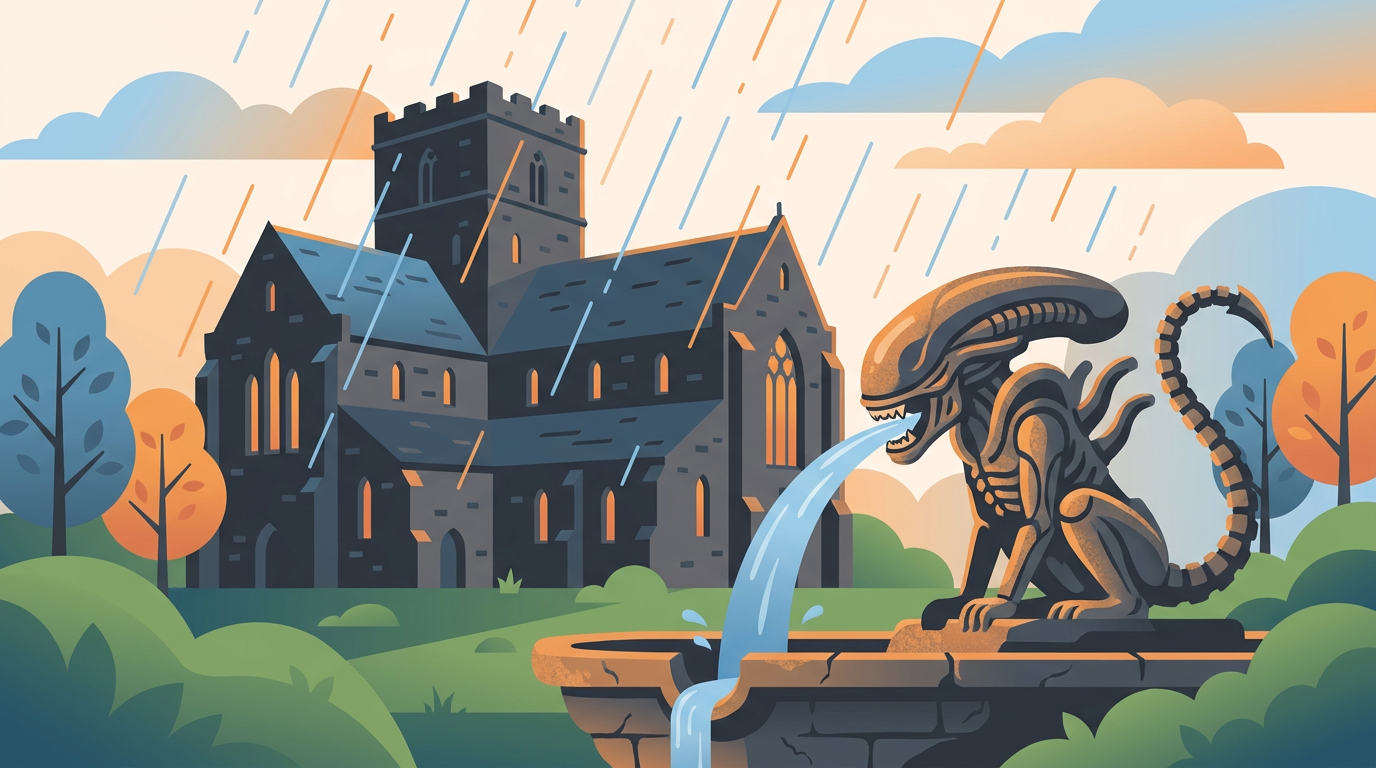
If you ever find yourself strolling around the venerable grounds of Paisley Abbey in Renfrewshire, Scotland, you will encounter centuries of breathtaking medieval craftsmanship. You will gaze upon majestic Gothic arches, ornate stained glass, weathered stone saints—and, perched rather casually on the roofline, an apex extraterrestrial predator waiting to pop a miniature mouth out of its maw.
Yes, an authentic H.R. Giger-style Xenomorph from the legendary 1979 sci-fi classic Alien is currently pulling sentry duty on an ancient Scottish abbey. And contrary to what the internet frequently assumes, it wasn't the work of a time-traveling cinephile or an unauthorized weekend prank. It was an act of devout historical accuracy.
The Unbreakable Rule of the Grotesque
To understand how Ridley Scott's nightmare creature scored a gig with the Church of Scotland, you have to rewind to 1991. The abbey was undergoing a massive conservation project. Centures of wet Scottish weather had done a number on the medieval masonry, and dozens of original gargoyles were crumbling away into unidentifiable limestone nubs.
When stonemasons were commissioned to carve replacements, they were handed a very specific brief grounded in strict medieval tradition: no duplicates allowed.
Back in the Middle Ages, master masons were granted immense creative freedom when fashioning grotesques. A church wasn't supposed to feature a monotonous assembly line of identical cherubs. The masonry was meant to showcase wild diversity—snarling demons, comic caricatures, distorted faces, and whatever strange monsters lived in the folklore of the era. The only real requirement was that every single one had to be entirely unique.
Enter David Lindsay
Tasked with creating fresh faces for the roof, talented stonemason David Lindsay got to work. He dutifully carved traditional, timeless gargoyles. But with dozens of empty plinths to fill without repeating himself, he needed fresh inspiration.
Rather than sketching another garden-variety goblin or a bloated toad, Lindsay let modern mythology step in. He picked up his chisel and faithfully sculpted the elongated, ribbed biomechanical skull, sinewy neck, and horrifying visage of cinema's most terrifying space beast.
Crucially, Lindsay wasn't making decorative modern sculpture just for kicks. He was building a proper, functional gargoyle. By definition, a true gargoyle contains an internal conduit designed to channel rainwater away from stone foundations to prevent water damage (if it does not carry water, it is merely a grotesque). So, rather than spraying concentrated acid blood, this particular Xenomorph was engineered to politely spit Scottish rainwater into the drainage gullies below.
The World Discovers the Alien in the Belfry
For roughly two decades, the extraterrestrial water spout lived in relative peace, keeping the masonry dry and spooking only the most observant birdwatchers. But then visitors started snapping high-zoom digital photographs.
Once the snapshots hit the web, the abbey experienced a full-blown viral eruption. Phone lines blew up. International broadcast networks sent camera crews to Paisley. David Lindsay’s family found their home telephone ringing off the hook with bewildered journalists demanding to know if an ancient monastery was secretly honoring extraterrestrial overlords. Even the abbey’s head minister found himself calmly explaining to television crews why a Hollywood horror icon was jutting out from his sanctuary’s rooftop.
The Otterly Interesting Part
There is something wonderfully poetic about the Paisley Abbey Xenomorph. In the fourteenth century, carvers sculpted horrific dragons and horned fiends because those were the monsters lurking at the edges of their cultural map. They believed grotesque carvings could frighten away actual evil spirits.
Fast-forward eight centuries, and humans are no longer kept awake by the thought of swamp ghouls. Our collective cultural nightmares live in deep space. By chiseling the creature that haunted twentieth-century movie theaters, Lindsay was not desecrating medieval tradition—he was honoring it in the most authentic way imaginable.
Next time you find yourself battling a stubborn downpour, just remember: somewhere in Scotland, there is a legendary space monster diligently working the day shift as a gutter pipe, and doing a stellar job at it.
Keep exploring
- Before Giant Balloons Ruled Thanksgiving, Macy’s Paraded Live Zoo Animals Down Broadway
- That Time Charles Darwin Swore a Scottish Mountain Was a Beach Resort
- How Helping a Buddy Look for a Lost Tool Made Two Men Millionaires
- Take an Otter quiz
Otterly agree? Tell us why.
Join the conversation
Kind, funny and useful takes only — that's the otter way.
Loading comments…