That Time Douglas Adams Accidentally Predicted the Internet (With Help From Doctor Who)
Months before the World Wide Web officially launched, the author of The Hitchhiker’s Guide to the Galaxy mapped out digital assistants, interactive media, and endless link-hopping.
In September 1990, the world was a very different place. If you wanted to learn about a obscure historical event, you couldn't just tap a piece of glass in your pocket. You had to physically walk to a library, hope the encyclopedias weren't checked out, and physically flip through pages.
Enter Douglas Adams. Already famous for The Hitchhiker’s Guide to the Galaxy, writing for Monty Python, and occasionally slinging a guitar on stage with Pink Floyd, Adams had a mind that simply refused to live in the present. In late 1990, he presented a television special titled Hyperland—and in doing so, he laid out a surprisingly accurate blueprint for our modern digital lives.
The wildly impressive part? He wrote and filmed the entire thing months before Tim Berners-Lee officially launched the world’s first World Wide Web server at CERN.
Falling Asleep in Front of the Box
The narrative hook of Hyperland is brilliantly simple. Adams sits in an armchair, grows increasingly bored with the rigid, linear nature of traditional television, and falls asleep. In his dream, he dumps his old TV into a dumpster and steps into a futuristic landscape where information isn't fed to you—you explore it.
Instead of flipping channels, Adams wanted to bounce from topic to topic based on pure curiosity. To make sense of it all, he introduced a concept inspired by early computing breakthroughs like Apple’s HyperCard and Vannevar Bush’s legendary Memex concept.
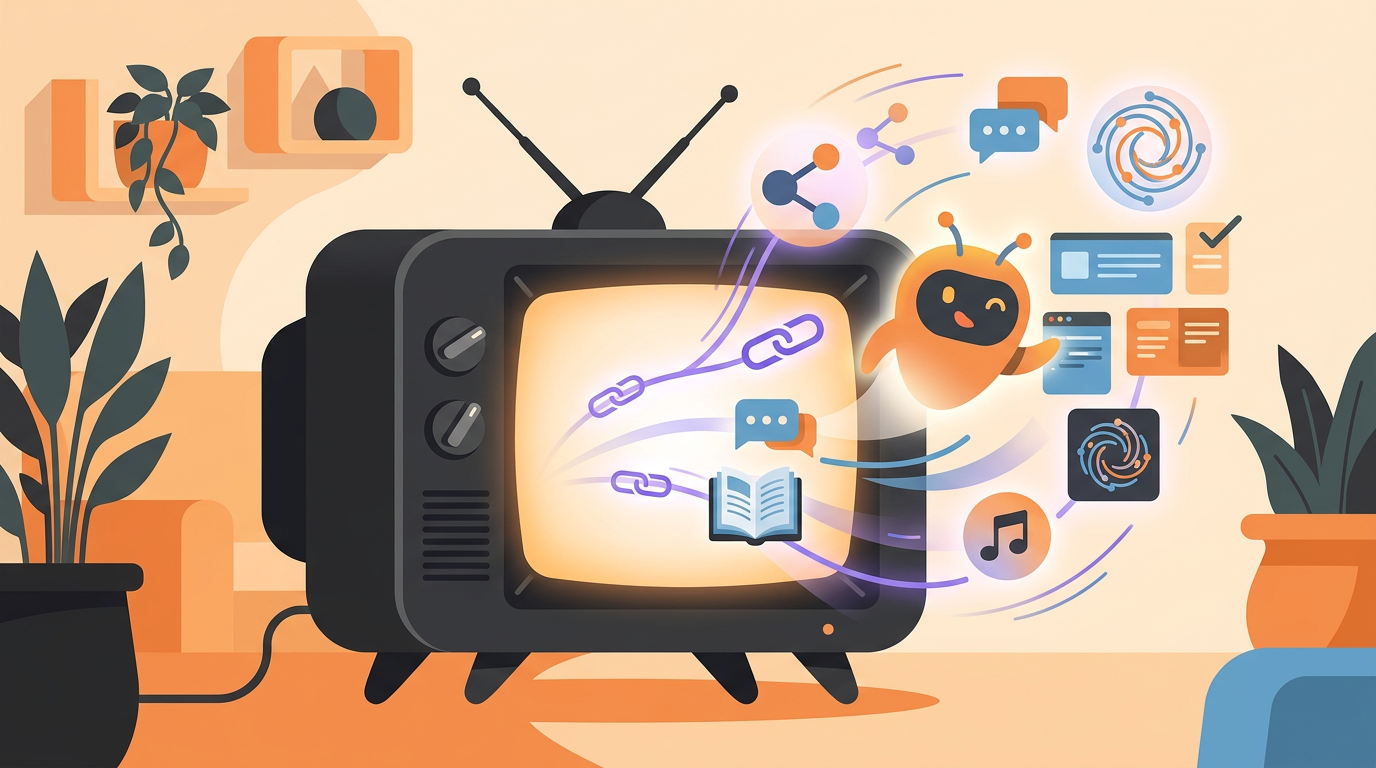
To help viewers get their heads around the idea of jumping non-linearly between text, video, and audio, the show used moving animated icons. They called them "micons"—which were essentially video-based hyperlinks thirty years ahead of their time.
Meet Tom, the World’s First Siri
Navigating this giant web of interconnected knowledge required a guide. So Adams created an artificial software agent named Tom, played by legendary Doctor Who actor Tom Baker.
In the program, Tom acts as a smart digital butler. He lives inside the machine, learns Adams’ personal preferences, answers questions conversationally, filters out irrelevant media, and fetches custom video clips on demand.
If that sounds familiar, it's because you probably asked a very similar virtual assistant what the weather was like this morning. Long before voice-activated AI became a standard smartphone feature, Adams and Baker showed millions of viewers exactly how human-computer interaction would feel in the 21st century.
Brainstorming the Future
Adams didn't just dream this up out of thin air. He spent the special chatting with forward-thinking computer pioneers, including visionaries like Ted Nelson (who coined the term "hypertext") and media producer Robert Abel. Together, they discussed a world where media wouldn't just sit on a shelf, but connect in an infinite, interactive web.
When Hyperland aired on BBC2 in late 1990, it must have felt like pure science fiction to the average viewer. To us, looking back, it feels like somebody filmed a documentary about Tuesday afternoon in 2024 using 1990s graphics.
The Otterly Interesting Part
What makes Adams’ vision so striking isn't just that he got the technology right—it's that he got the vibe right. Science fiction often envisions the future of computing as cold, sterile, and intimidatingly military. Adams saw it as warm, conversational, slightly chaotic, and deeply fun. He correctly guessed that what people really wanted wasn't just raw computational power, but a playful tool to satisfy everyday human curiosity.
So the next time you find yourself tumbling down a three-hour rabbit hole starting at a recipe and ending on the history of deep-sea sponges, give a quiet nod of thanks to Douglas Adams. He saw you coming decades ago.
Keep exploring
- Tiny Wings, Huge Commute: The Epic Monarch Journey Arrives in NYC
- Why Are Parrots Obsessed With Making Fart Noises? Science Has an Answer
- What 54 Roman Emperors Actually Looked Like (Minus the Marble)
- Take an Otter quiz
Join the conversation
Join the conversation
Kind, funny and useful takes only — that's the otter way.
Loading comments…