
An Engineer Spent Months Teaching a Stick How to Stand Up—Using Drone Propellers
Balancing a broom handle on your open palm is a classic party trick. Doing it with flight dynamics software and mini quadcopter blades is absolute wizardry.
We have all been there. You are sweeping the kitchen, you get momentarily distracted, and suddenly you are trying to balance the broom upright on the tip of your index finger like a circus performer. It works for about four seconds before the broom gracefully swoops into your coffee mug.
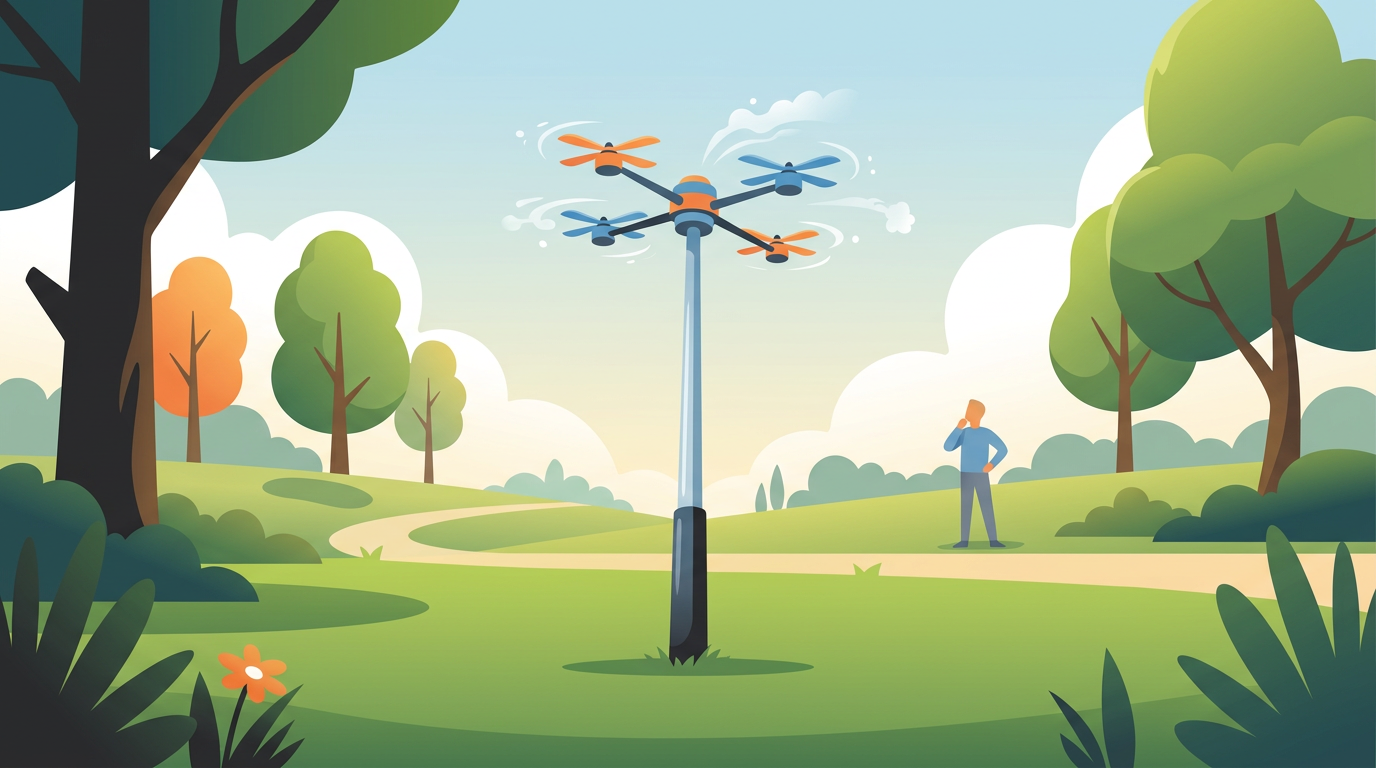
Flight dynamics engineer Peter Ryseck decided to tackle this exact gravitational indignity, except he brought serious aerospace hardware to the fight. Instead of relying on human reflexes, he built a custom pole equipped with quadcopter propellers that continuously fights physics to stay upright completely on its own.
Big Blades, Bigger Problems
Ryseck is no stranger to putting thrust on things that fly. Long before he was working on modern aircraft, he spent his childhood building remote-controlled planes in his parents' basement. So when it came to keeping a vertical pole standing straight up, his instinct was simple: slap some motors on it.
His initial prototype featured 10-inch propellers mounted near the top. In theory, if the pole tilted left, the left motor would spin up, push it back right, and save the day. In reality, physics had other plans. Those larger 10-inch blades had too much rotational inertia, meaning they could not speed up or slow down fast enough to make the split-second corrections needed to keep the stick upright. The result was a wobble that quickly turned into a dramatic crash.
Shrinking the Fans and Taming the Vibe
To solve the latency issue, Ryseck swapped out the large blades for smaller 5-inch propellers. Because smaller blades have much less mass, they can change speeds almost instantly, executing hundreds of micro-adjustments per second.
That fixed the response time, but it unveiled a brand-new mechanical headaches: flex. Unlike a rigid metal rod in a simulation, real-world poles bend. As the tiny motors whipped around, the pole began to vibrate at its own natural physical frequency, confusing the onboard sensors into thinking the whole device was tipping over.
To keep the pole from vibrating itself into chaos, Ryseck wrote a dynamic notch filter into the software. This clever digital filter singled out the exact frequency of the physical flex and ignored it, allowing the control system to focus strictly on keeping the pole vertical.
Taking a Stand in Munich
With the hardware dialed in and the software tuned, Ryseck added smart code that allowed the pole to re-center its vertical baseline and actively lean directly into steady breezes.
To test it out, he took the contraption to Olympiapark in Munich. There, surrounded by curious onlookers, the high-tech stick stood tall, hovering serenely in place against steady winds for over three hours straight.
The Otterly Interesting Part
What makes this project so delightfully ridiculous is how it highlights the gap between human intuition and machine precision. When you balance an object on your hand, your brain calculates muscle micro-tremors subconsciously through visual cues and joint feel. Recreating that basic human impulse with code requires dynamic math, vibration filtering, and rapid motor response. It turns out that looking cool at a dinner party takes an awful lot of linear algebra.
Whether it is solving urban mobility or just convincing a piece of hardware to stand upright in a public park, there is something wonderfully joyful about watching high-level flight math applied to the simplest objects around us.
Keep exploring
- Why Are We Like This? The Joy of the 2 A.M. Internet Rabbit Hole
- A Stranded Traveler Stepped Outside O'Hare and Found the Tiny Co-Pilot of His Dreams
- Real Dino Blood Survived 115 Million Years Thanks to a Microscopic Mineral Time Capsule
- Take an Otter quiz
Otterly agree? Tell us why.
Join the conversation
Kind, funny and useful takes only — that's the otter way.
Loading comments…