
The Galaxy Has a New Youngest Planet, and It Is Basically Still Swaddled in Stardust
Move over, five-million-year-old cosmic toddlers. A newly identified Jupiter-sized world is making planetary history while still clearing out its messy cosmic nursery.
Welcome to the Cosmic Nursery
Break out the blue cigars and silver rattles: the universe officially has a new youngest planet. Astronomers have spotted a cosmic newborn named Elias 2-24 b, and when we say young, we mean it. This planetary infant is less than one million years old.
To put that into perspective, our own Earth is roughly 4.5 billion years old. Previous contenders for the title of youngest planet were tied at a relatively ancient five million years old. So Elias 2-24 b isn't just young; it's practically a newborn still kicking around in its cosmic bassinet.
Digging Through the Archives for Stardust Infants
Located about 450 light-years away from Earth, this freshly minted world is roughly the mass of Jupiter. But what makes its discovery even cooler is how researchers found it. Instead of waiting for telescope time to observe a new target, a team led by Andrea Bernardi, a doctoral student at Universidad Diego Portales in Chile, went digital spelunking.
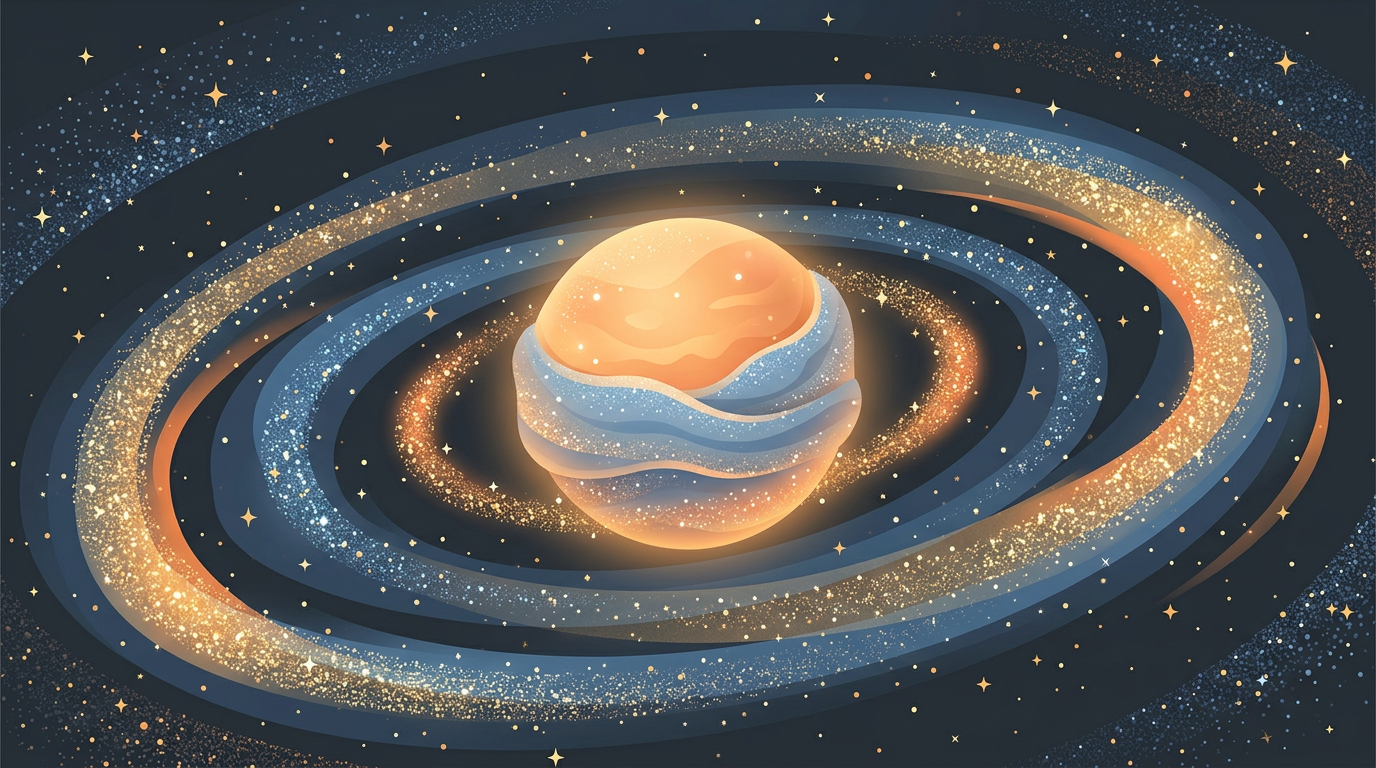
By combing through archival data gathered by Hawaii's W. M. Keck Observatory, the researchers specifically searched for gaps in the dusty disks of debris that circle young stars. When a brand-new planet orbits its parent star, it acts like a giant, gravitational snowplow, sweeping away dust and clearing a ring-shaped path. By hunting for these distinct structural clearings, the team located the infant world hiding right inside one of the gaps.
The Otterly Interesting Part
Here's why this is such a fun turn of events for astronomy enthusiasts. Out of the roughly 6,000 exoplanets we have discovered so far, the vast majority are mature, billions-of-years-old worlds detected when they pass directly in front of their host stars. Finding a planet this young—while it is actively carving out its neighborhood from a thick swirl of cosmic dust—is like capturing a video of a baby taking its very first steps in a room full of toys.
It proves that planets can grow big fast, sweeping up their surrounding gas and dust before their star even finishes clearing out the neighborhood.
A Fresh Perspective on Planetary Birth
It turns out you don't always need to point a telescope at something brand new to make a groundbreaking discovery; sometimes the universe's best-kept secrets are waiting inside dusty data folders right here on Earth.
So, what do you get the Jupiter-sized baby world that has everything? Probably a couple more million years to clean up its orbit. But for now, we're just excited to welcome the newest member to the planetary family album.
Keep exploring
- How Childhood Went From 'Here's a Rock' to 'Give Me a Touchscreen'
- London’s Quietest Neighbors Have Been Hiding a Massive Secret Since 1868
- Why Wombats Poop in Cubes (and Why Physics Loves Them for It)
- Take an Otter quiz
Join the conversation
Join the conversation
Kind, funny and useful takes only — that's the otter way.
Loading comments…