
Construction Workers Dug Up an Ancient 65-Foot Travel Bug in Brazil
A routine excavation in Davinópolis unearthed a 20-meter dinosaur whose closest relative lived all the way across the Atlantic in Spain.
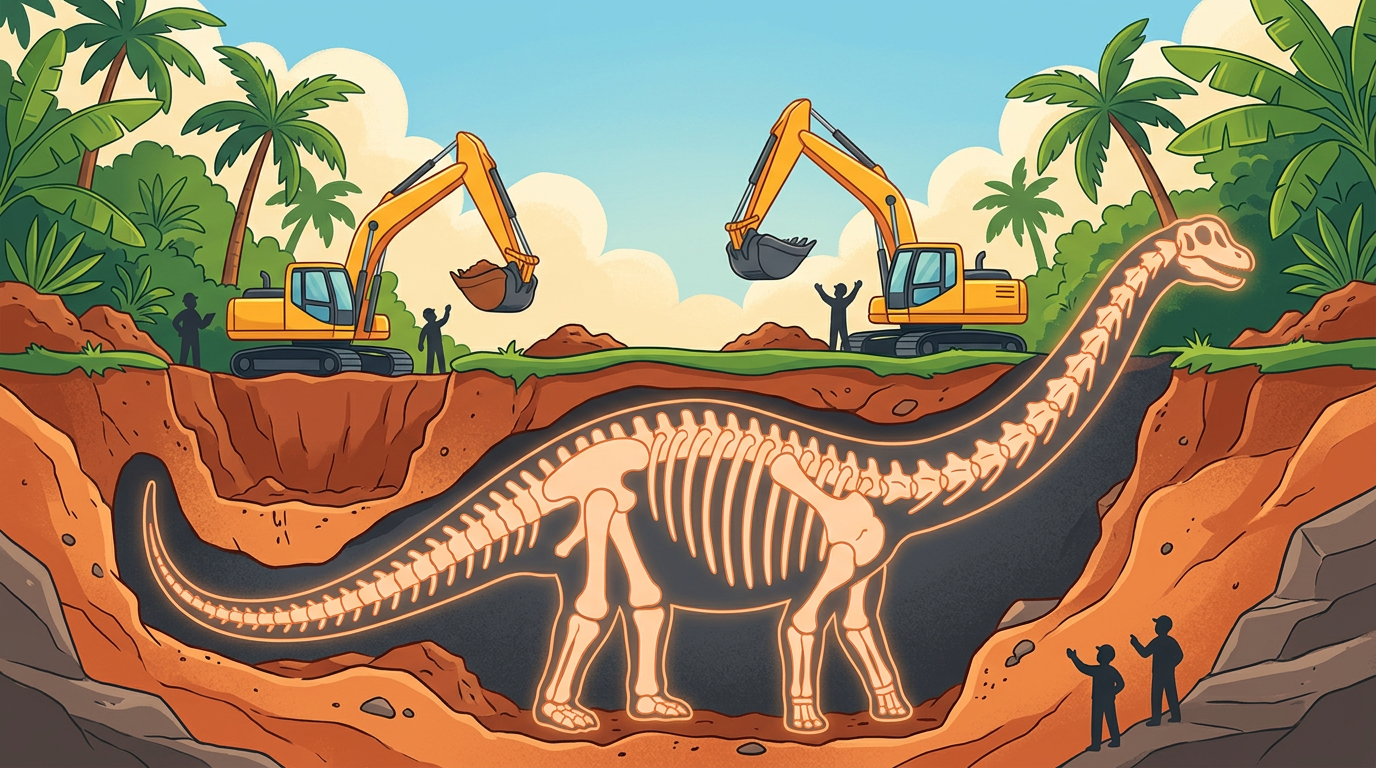
Imagine showing up for a standard shift at a construction site, revving up the excavators to build a new road-rail terminal, and hitting something hard enough to pause the whole operation. You expect bedrock, maybe an old pipe, or at worst a giant rock. You probably do not expect to hit a 120-million-year-old long-necked giant that out-sizes every fossil ever found in the region.
That exact surprise unfolded in Davinópolis, located in the state of Maranhão, Brazil. Crews digging down eight meters into the earth scraped against the massive fossilized remains of a brand-new dinosaur species: Dasosaurus tocantinensis.
A Case of Prehistoric Mistaken Identity
When monitors on the site first spotted the gigantic bones, they did not immediately jump to "giant Cretaceous sauropod." In fact, archaeologists initially guessed the fossils belonged to much younger prehistoric mammals—the kind of ice-age megafauna that shared the landscape with early humans.
It was only when a specialist in recent mammals took a closer look that the lightbulb went off. Buried eight meters deep, these bones were far too deep and far too ancient for giant sloths or mammoths. The site was actually holding a creature that walked the earth roughly 120 million years ago.
What makes this find extra special for palaeontologists is how well-preserved the skeleton is. Excavators recovered tail vertebrae, ribs, limb bones, and a femur measuring a staggering 1.5 meters long. Altogether, Dasosaurus tocantinensis stretched about 20 meters from snout to tail tip, effectively doubling the size of the previously known local record-holder, the 10-meter Amazonsaurus maranhensis.
The Jet-Setting Sauropod
Beyond its massive frame, this newcomer came with a fascinating plot twist. When researchers analyzed the bone structure, they discovered that its closest known evolutionary relative was not another South American giant—it was a dinosaur found in Spain.
How does a 65-foot herbivore end up with family across an ocean? Back in the Early Cretaceous period, Earth's continents were still shifting out of the supercontinent Pangaea. The evolutionary link between South American and European species suggests that land bridges once connected South America, Africa, and Europe, allowing these gentle giants to wander across prehistoric continents before continental drift pushed them apart.
The Otterly Interesting Part
It is delightfully wild to think about how much history is literally hanging out under our boots. Construction projects pull up all sorts of modern artifacts, but every once in a while, a shovel hits a jackpot that completely redraws our map of ancient history. A 20-meter intercontinental traveler sitting eight meters beneath a modern transit hub is the ultimate reminder that the Earth has been busy long before we started paving over it.
So next time your bus is delayed or a road project takes an extra few months, just remember: it could be worse. They could be excavating a 65-foot Spanish-connected sauropod out of the foundation.
Keep exploring
- The Internet Found a Surprisingly Wholesome Use for 'Catfishing'
- Map of America’s Most Popular Dogs Reveals a Surprising Desert Plot Twist
- Scientists Are Strapping Tic Tac-Sized Backpacks on 'Butter-Butts'
- Take an Otter quiz
Otterly agree? Tell us why.
Join the conversation
Kind, funny and useful takes only — that's the otter way.
Loading comments…