
The Slowest, Heaviest Text Message in Human History Just Arrived in a Bathroom
When Wi-Fi fails through a thick brick wall, the obvious solution is hauling nearly two tons of steel up and down a vintage elevator shaft.
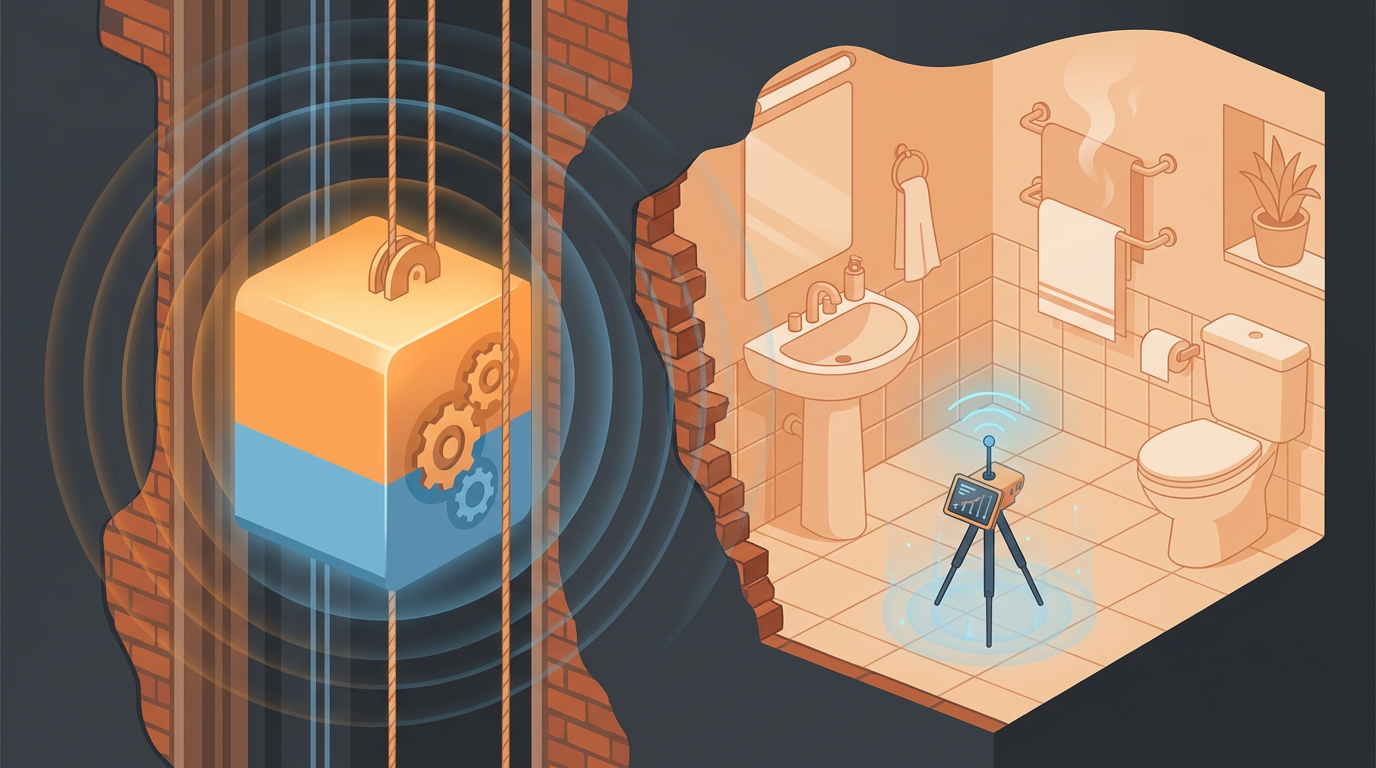
We have all experienced the sudden, soul-crushing tragedy of entering a bathroom only to watch our phone signal instantly vanish. Thick concrete and brick walls are practically engineered to eat electromagnetic radiation for breakfast.
Naturally, physicists at the University of Queensland found a workaround. It does not require Wi-Fi, cell towers, or satellite beams. You just need an ultra-sensitive sensor, a solid brick barrier, and a 1.8-metric-ton vintage elevator counterweight to haul up and down like a mechanical workout routine.
Welcome to gravitational communication: easily the clunkiest, slowest, and most gloriously unstoppable messaging system ever tested.
The Two-Ton Morse Code Machine
The experiment took place inside the university's Parnell Building. Instead of sending out radio waves—which can be scrambled, jammed, or blocked by steel and stone—the researchers relied on basic physics: every physical object with mass exerts a gravitational pull.
Move a massive object, and you slightly alter the gravitational field around it. To turn this principle into data, the team hijacked an existing elevator and treated its hefty 1.8-ton counterweight as a binary transmitter. Moving the counterweight between two specific floor levels created tiny, predictable gravitational shifts. Up meant one thing; down meant another.
It was digital binary code, powered entirely by hauling a small car’s worth of metal back and forth through a shaft.
Dial-Up From the Restroom
Every message needs a receiver. For this experiment, the team stationed an ultra-precise instrument called a gravimeter in an adjacent room on the other side of a solid brick wall. That room happened to be an ordinary bathroom.
As the counterweight trundled up and down on its cables, the gravimeter dutifully picked up the microscopic changes in gravitational acceleration rippling through the brickwork. Unlike your home router's radio waves, gravity literally could not care less about masonry. You cannot shield it, reflect it, or hide from it with a tinfoil hat. The mass moved, the field bent, and the sensor in the bathroom recorded every tug.
Bit by bit, pulse by agonizingly slow pulse, the transmission was assembled. The final decoded text?
A single, thoroughly earned word: Gravity.
The Otterly Interesting Part
Perhaps the best part of this whole stunt is that nobody set out to build an absurdly heavy bathroom telegraph. The experiment actually grew out of a practical engineering question: how to weigh massive commercial trucks on highways without forcing them to stop on a platform scale.
The team had been exploring whether ultra-sensitive gravity detectors could measure a heavy semi-truck simply as it rolled past at highway speeds. Realizing that moving mass equals readable gravitational data, someone inevitably looked at an old freight elevator and asked the timeless mad-scientist question: Can we use this to send a text?
Don't Cancel Your Cell Plan Just Yet
Before you ask your landlord to install a two-ton pulley system to fix the dead zone in your hallway, the researchers are the first to admit this is wildly impractical for daily life. The data transfer rate makes 1990s dial-up look like fiber optics, and you probably do not want a multi-ton iron weight rattling outside your bedroom wall whenever someone sends a meme.
Still, as a proof of concept, it is wonderfully stubborn science. If humanity ever truly needs to send an unjammable signal through solid bedrock, the template is ready. All you need is a massive block of steel, a little patience, and a comfortable seat in the bathroom.
Keep exploring
- Sea Urchins Are Rocking Seashell Sombreros, and Honestly, It's Pure Genius
- When Uncle Sam’s Fictional Better Half Solved Marriage’s Oldest Argument
- Roll for Initiative, William: What If the Bayeux Tapestry Was Your Campaign Map?
- Take an Otter quiz
What's your take?
Join the conversation
Kind, funny and useful takes only — that's the otter way.
Loading comments…