
Forget Potatoes: Your Future Mars Diet Is Going to Be Mostly Kale
Scientists tested dirt meant to mimic the Red Planet—and discovered that leafy greens thrive in space soil.
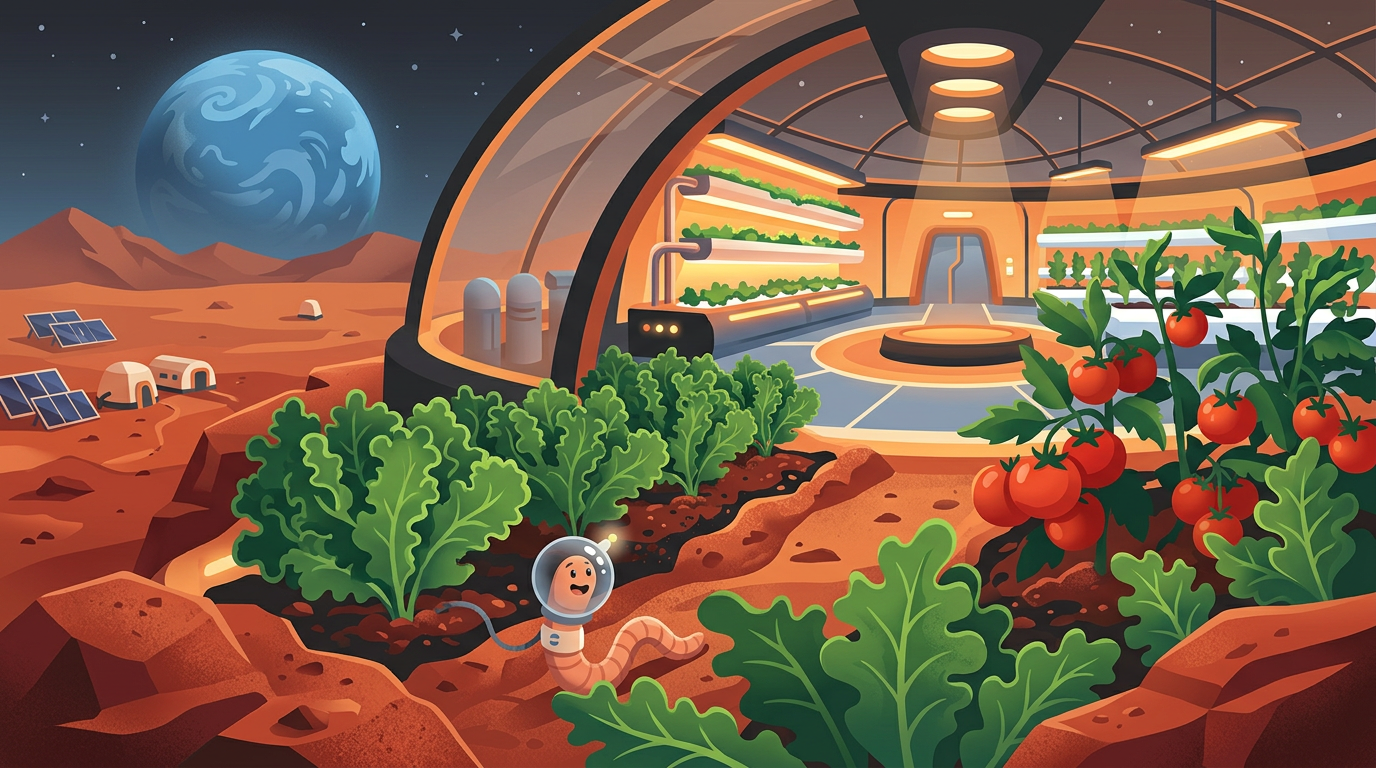
Pop culture promised us that when humans finally settle on Mars, we’ll survive by growing nice, comforting potatoes in our habitat greenhouses. But real-world science has a slightly different, much crunchier vision for your off-world dining experience. Get ready for space kale, fertilized by human manure and tilled by earthworms.
It all started back in 2013 with a botanist named Wieger Wamelink. As a child, Wamelink dreamed of becoming an astronomer before eventually turning his scientific passion toward plant biology. But he never quite lost his taste for the cosmos. He found himself asking a delightfully bizarre question: if we ever pack up and head to the Red Planet, could we actually grow food in Martian dirt?
To find out without leaving Earth, Wamelink got his hands on simulated Martian regolith—a special dirt mix made from crushed Earth volcanic rock that scientists typically use to test rover wheels and space suits. On paper, this stuff is a botanical nightmare. Mock Martian soil repels water, contains zero organic material, and is spiked with toxic chemicals called perchlorates along with heavy metals.
Undeterred, Wamelink launched an ambitious experiment, planting 4,200 seeds across 14 different plant species into the crushed volcanic dust. The results were startling. Almost all of the seeds germinated, with some eager sprouts poking through the dirt within just 24 hours.
Of course, getting a seed to sprout is one thing; raising an edible crop in toxic, nutrient-free dust is another. To turn this hostile dirt into a functioning ecosystem, the research team had to get creative. They added pig manure and human manure for nutrients, dropped in earthworms to mix the soil and create aeration, and introduced special perchlorate-consuming bacteria to neutralize the toxic chemicals.
Once the soil ecosystem was firing on all cylinders, the crops took off. The team successfully grew tomatoes, garlic, spinach, basil, lettuce, rocket, onions, radishes, and kale. But the biggest plot twist came from the leafy greens: kale didn't just survive in the simulated Martian dirt—it actually grew better there than in standard Earth soil. Meanwhile, the pop-culture favorite potato proved far trickier and more finicky to cultivate than leafy greens.
By 2016, after rigorously testing the produce to ensure it hadn't absorbed dangerous levels of heavy metals from the volcanic dirt, Wamelink held a historic, multi-course dinner party for the sponsors and team. The main course? Freshly harvested crops grown entirely in simulated Mars regolith.
The Otterly Interesting Part
It turns out that establishing a permanent home on another planet isn't just about build-it-yourself rockets or sleek sci-fi habitats—it’s fundamentally about aggressive, high-tech composting. The very first delicacy enjoyed by human pioneers on Mars might not be a freeze-dried steak or a hearty baked potato, but a peppery rocket and kale salad fertilized by yesterday's crew meetings.
While there is still plenty of testing ahead—since real Martian conditions involve lower gravity and harsh radiation that earthbound experiments can't fully replicate—one thing is already clear: the future of space exploration is going to involve a lot more salad than anyone expected.
So if you’re planning on signing up for a one-way ticket to Mars, you might want to start learning to love kale now. Would you brave a Mars-grown salad, or are you holding out for space fries?
Keep exploring
- Love Instant Photos But Hate Clutter? This Camera Prints Rewritable Snapshots
- Before GPS, WWII Aircrews Trusted Their Lives to These Absolute Units of the Sky
- Before Screens, We Had Flames: How Campfires Invented Nighttime Storytelling
- Take an Otter quiz
What's your take?
Join the conversation
Kind, funny and useful takes only — that's the otter way.
Loading comments…