How Two Baseball Players Accidentally Invented Humanity's Favorite Celebration
On an October afternoon in 1977, a spontaneous gesture at home plate changed how the entire world celebrates the little things.
Think about the last time you pulled off something mildly impressive. Maybe you caught a falling glass before it hit the floor, or finally remembered your password on the third try. What did you do? You probably raised a hand, caught the eye of the nearest human, and delivered a crisp, resounding high five.
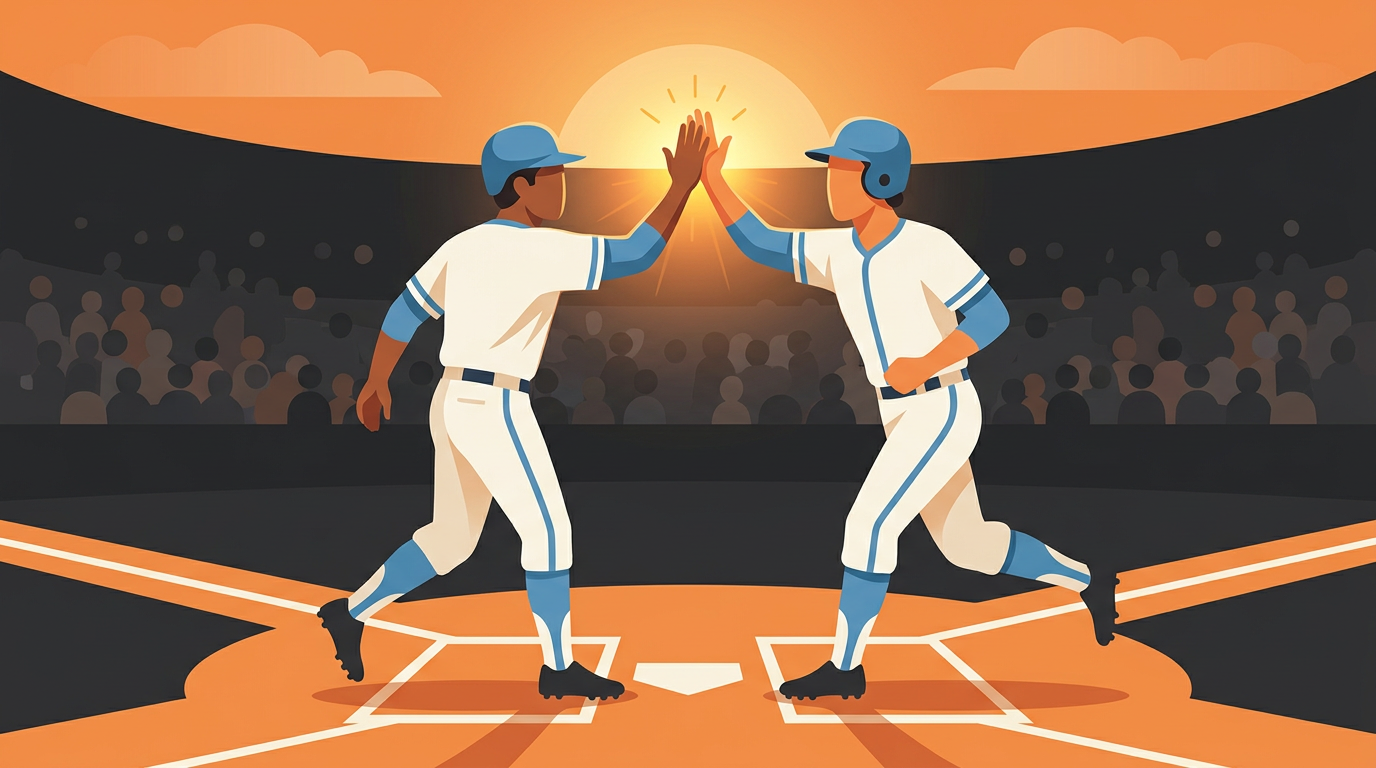
It feels like a gesture as old as time, but here is the delightful truth: before the late 1970s, practically nobody was high-fiving. The entire world was sticking to low-fives, handshakes, or polite head nods. That all changed on October 2, 1977, thanks to two teammates standing near home plate at Dodger Stadium.
The Moment at Home Plate
It was the final day of the regular baseball season, and Los Angeles Dodgers outfielder Dusty Baker had just hit a landmark 30th home run. The crowd was roaring, and the mood on the field was electric.
As Baker rounded third base and crossed home plate, his teammate Glenn Burke was waiting for him on the deck. Burke was so completely overcome with happy energy that he did something nobody had thought to do before. He raised his right hand straight up into the air, palm open, reaching towards the sky.
Baker, having no pre-existing playbook for what to do with a giant hand floating above shoulder height, simply reached up and slapped it.
It was loud, it was triumphant, and it felt fantastic. Baker later admitted he did not really know why Burke had his hand up there, but it just made sense to hit it. And just like that, the high five was born.
More Than Just a Game
The gesture quickly caught fire, leaping off the athletic field and into general global social customs throughout the late 1970s and 1980s. But for Glenn Burke, it became something even deeper.
Burke was one of the first openly gay professional athletes, and he used the high five as a prominent emblem of identity, visibility, and solidarity. On and off the field, the high five became a warm, joyful greeting that brought people together and communicated acceptance without needing a single word.
The Otterly Interesting Part
Here is what makes the high five so special: it is almost impossible to perform insincerely. Have you ever tried to give a sarcastic high five? It instantly collapses into an awkward air-miss. Because it requires two people to physically coordinate in mid-air above their shoulders, it demands genuine, shared presence. It is pure human connection compressed into a split second.
In 2002, a group of college students realized the world needed even more of that spontaneous joy, creating National High Five Day to encourage people to share simple, positive interactions with anyone who could use a boost.
High Five Yourself Today
The next time you land a perfect palm-slap with a friend or coworker, take a quick second to appreciate Glenn Burke and Dusty Baker improvising on a sunny afternoon in 1977. It turns out one of our most universal everyday habits was not designed by a committee or tested in a lab—it was just two people sharing an unscripted moment of pure joy.
Keep exploring
- Forget Potatoes: Your Future Mars Diet Is Going to Be Mostly Kale
- Love Instant Photos But Hate Clutter? This Camera Prints Rewritable Snapshots
- Before GPS, WWII Aircrews Trusted Their Lives to These Absolute Units of the Sky
- Take an Otter quiz
Have something to add?
Join the conversation
Kind, funny and useful takes only — that's the otter way.
Loading comments…