Why Spend Millions on De-Aging CGI When You Can Just Cast the Actor’s Kid?
Before spending a fortune on uncanny digital de-aging, directors often rely on the ultimate biological cheat code: DNA.
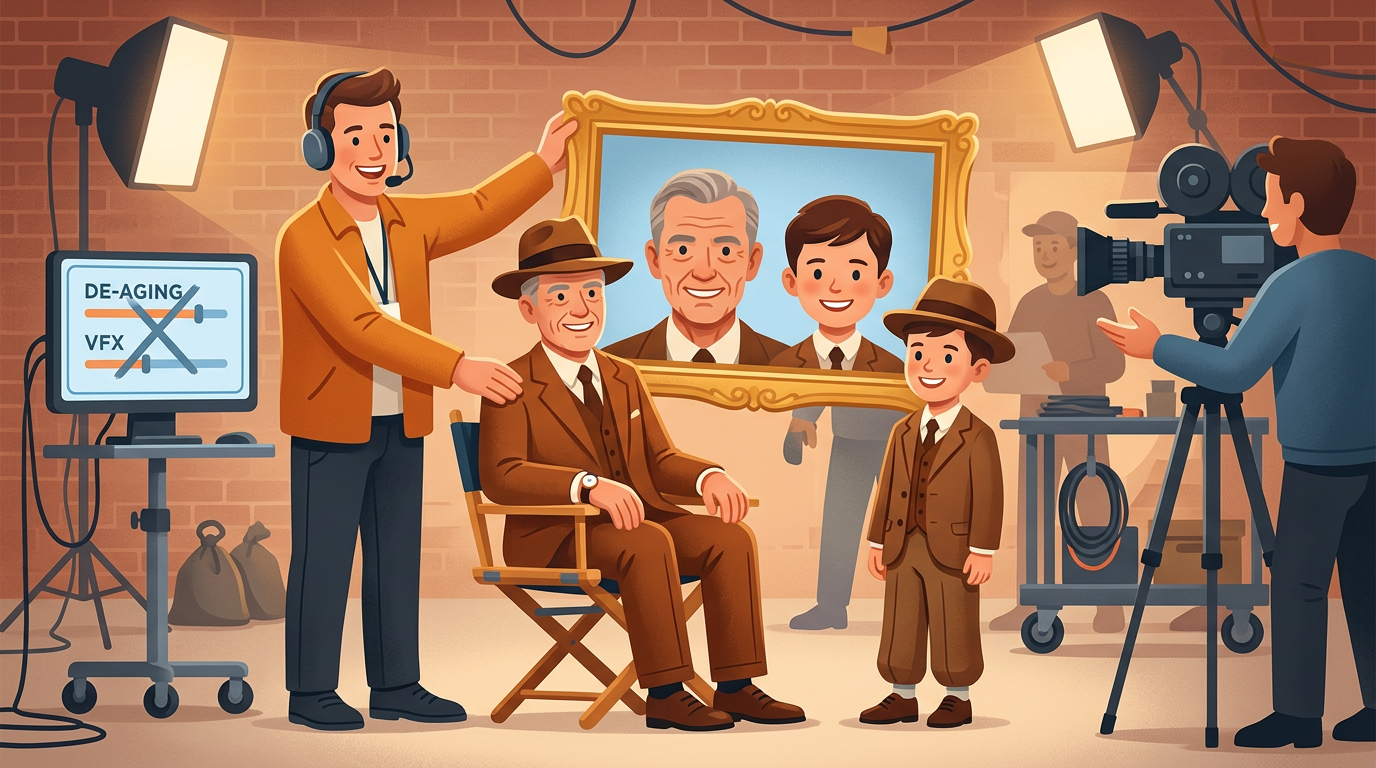
We live in a golden age of digital visual effects. If a film director wants a beloved actor to look twenty-five again for a quick flashback, they can throw a couple million dollars at a VFX house to smooth out the wrinkles. But as anyone who watched early digital de-aging knows, the result can sometimes look less like a young movie star and more like a glossy video game character who lost their soul.
Turns out, nature already figured out a far more believable solution billions of years ago. It’s called genetics. Every now and then, Hollywood casting directors bypass the tech department entirely and simply call up the lead actor’s real-life kid. The resemblance is baked into their very code, saving budget money and avoiding the dreaded uncanny valley in one brilliant move.
The Mugshot Cheat Code
Take the classic prison drama The Shawshank Redemption. There is a famous moment where prison administrators flip open the parole file of Ellis Boyd "Red" Redding, played by Morgan Freeman. Included in the file is a youthful mugshot of a young Red, taken decades earlier when he first arrived at the penitentiary.
Rather than attempting to retroactively edit an early headshot of Morgan Freeman or hire a lookalike model, the prop department did something far simpler. They snapped a mugshot photo of Morgan Freeman’s actual son, Alfonso Freeman. The genetic match was so seamless that audiences naturally accepted it as a vintage photograph of the Hollywood legend himself.
The Sitcom Copy-Paste
It’s not just single prop photos, either. Sometimes the biological copy-paste is strong enough to anchor entire storylines.
On 30 Rock, creator and star Tina Fey needed someone to play a young version of her character, Liz Lemon, during a quick flashback sequence to the 1990s. Instead of holding open auditions for a young actor who could nail the signature awkward energy, she cast her own seven-year-old daughter, Alice Richmond. Armed with matching glasses and identical facial expressions, the resemblance was instantly undeniable.
Then there is Young Sheldon, the prequel series centered on the childhood of The Big Bang Theory’s breakout character. In the original series, Sheldon’s mother, Mary Cooper, was brilliantly portrayed by Laurie Metcalf. When it came time to cast the younger version of Mary Cooper for the prequel, the show producers didn't have to look far. They hired Laurie Metcalf’s real-life daughter, Zoe Perry. The performance wasn't just a physical mirror image; Perry had spent her whole life absorbing her mother’s speech rhythms and mannerisms, creating one of the most natural casting fits in television history.
Walking in Big Footsteps
In some cases, hiring an actor's offspring goes far beyond a cute nod or a quick gag—it carries immense emotional weight.
When the biographical film Straight Outta Compton entered production, the filmmakers faced a daunting challenge: who could possibly play the legendary hip-hop icon Ice Cube with authentic swagger and presence? The answer was his real-life son, O'Shea Jackson Jr., who stepped into his father’s shoes so naturally that viewers forgot they weren't watching arch-rival footage from 1988.
A similar phenomenon occurred with The Many Saints of Newark, the feature film prequel to The Sopranos. Stepping into the shoes of the late James Gandolfini to play a teenage Tony Soprano was a monumental emotional task. His son, Michael Gandolfini, took on the role, capturing the subtle physical habits and heavy presence of his father in a way no outside actor ever could.
The Otterly Interesting Part
There is something deeply satisfying about watching biological continuity on screen. While computer-generated de-aging can map out facial structure down to the millimeter, it routinely misses the microscopic quirks of movement—the specific way someone squints, tilts their chin, or smirk when nervous. Kids spend years unconsciously imitating their parents' subtle body language. When you combine shared facial structure with decades of involuntary mimicry, you get a performance that no algorithm on Earth can replicate.
So the next time you see a shockingly realistic flashback in a movie, don't automatically assume it was rendered on a render-farm server. It might just be the result of a very efficient family tree.
Keep exploring
- How a 1990s Nun Living in a Camper Van Became the Internet's Favorite Art Critic
- Wile E. Coyote Is Finally Suing Acme, and Honestly? It’s About Time.
- The $25 Concert Gamble: Will You High-Five Olivia Rodrigo or a Venue Pigeon?
- Take an Otter quiz
Have something to add?
Join the conversation
Kind, funny and useful takes only — that's the otter way.
Loading comments…