The Asteroid Didn't Just Kill the Dinosaurs—It Upgraded the Ants
While T-Rex was having the worst day in history, tiny ant genomes were staging a massive genetic upgrade party thanks to rogue jumping genes.
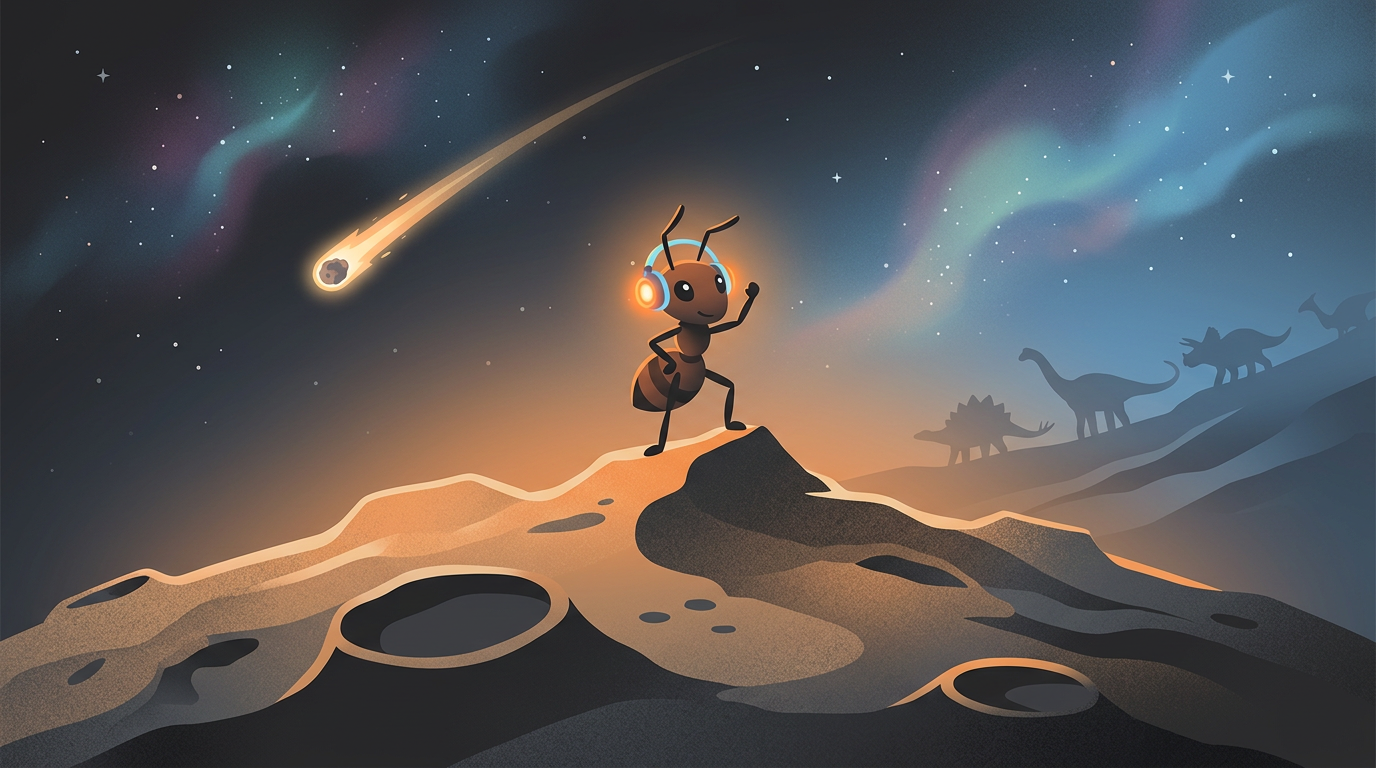
66 million years ago, a massive asteroid crashed into Earth and abruptly ended the age of the dinosaurs. It was, undeniably, a very bad Tuesday for the T-Rex. But while giant reptiles were exiting stage left, something truly wild was happening down in the soil. Deep inside the tiny bodies of surviving ants, a quiet genetic revolution was underway.
It turns out the fallout from that cosmic disaster didn't just clear out giant predators—it helped trigger a biological software update that allowed humble ants to build one of the most successful empires on the planet.
The Ultimate Cosmic Handoff
To understand how a giant space rock helped tiny bugs, you have to look at transposable elements, affectionately known as "jumping genes." These are mobile segments of DNA capable of duplicating themselves and hopping around to different positions within a genome. For a long time, scientists brushed off jumping genes as genomic parasites because they copy themselves like tiny hitchhikers without offering an obvious perk.
Except sometimes, jumping genes act like chaotic genetic improvers. During the early Paleogene period, right around 66 million years ago, ant genomes experienced massive surges in jumping gene activity. Similar bursts of jumping DNA have also popped up during key evolutionary eras for bats and primates, proving that a little genomic shuffling can lead to big evolutionary leaps.
Upgraded Biological Walkie-Talkies
So what happens when DNA segments start playing musical chairs inside an ant? In this case, the rapid shuffling expanded the gene families responsible for scent: odorant receptor genes.
Ants don't talk, text, or drop pins on a map. They communicate almost entirely through smell. They rely on chemical signaling to navigate their environment, identify colony mates, and coordinate complex tasks. The surge in jumping genes effectively handed early ants a shiny new set of biological walkie-talkies. With a vastly expanded sense of smell, they could form larger, more complex social networks and adapt to post-impact environments with remarkable speed.
The Otterly Interesting Part
A study led by Dr. Lukas Schrader at the Institute for Evolution and Biodiversity at the University of Münster revealed a fascinating pattern: the ant groups boasting the highest numbers of jumping genes back then are the very same lineages that feature the greatest species diversity today. Today, ants represent the largest family of social insects on Earth, boasting more than 15,000 species worldwide.
Now, researchers aren't asserting that jumping genes were the single decisive factor that allowed ants to outcompete other survivors, nor do we know the exact environmental triggers that caused the genes to suddenly jump into action right after the impact. But the timing is undeniably cosmic.
The Earth's New Roommates
While we usually picture the post-asteroid world as a gloomy wasteland, for ants, it was an unprecedented land of opportunity. Equipped with upgraded chemical sensors and fueled by evolutionary momentum, they quietly set out to conquer virtually every corner of the globe.
So the next time an ant marches across your kitchen counter or crashes your picnic, give it a little nod of respect. You aren't just looking at a tiny intruder—you're looking at a survivor whose ancestors took a world-ending catastrophe and turned it into the ultimate group chat upgrade.
Keep exploring
- Seven Grain Heads on One Stalk? How Attic Clutter Sprouted an Agricultural Wonder
- How a Boisterous German Artist Taught a Soft-Spoken Air Force Veteran to Paint Happy Little Trees
- The Time Liechtenstein Sent 80 Soldiers to War and Came Back With 81
- Take an Otter quiz
Join the conversation
Join the conversation
Kind, funny and useful takes only — that's the otter way.
Loading comments…