Before Screens, We Had Flames: How Campfires Invented Nighttime Storytelling
That late-night urge to gossip under the covers isn't a modern flaw—it's your ancestral DNA begging for a campfire narrative.
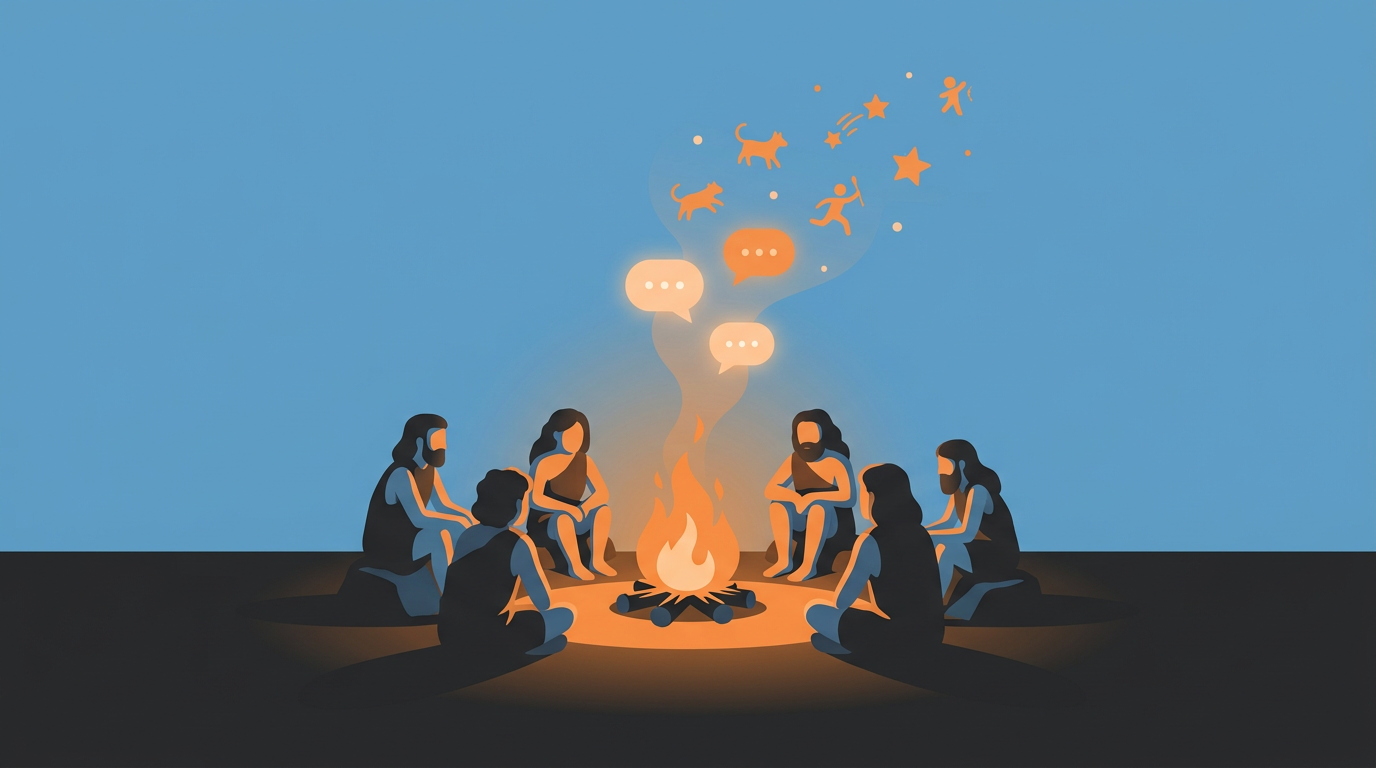
Ever find yourself wide awake at 11:30 PM, scrolling through group chats under the dim glow of your phone screen? Before you scold yourself for terrible sleep habits, give yourself a break. That late-night urge to share gossip in the dark isn't a modern character flaw—it is practically hardwired into your prehistoric DNA.
Long before smartphones ruled our bedtime routines, our early ancestors were sitting around campfires doing the exact same thing. And as it turns out, the cozy, flickering light of those ancient flames played a surprisingly massive role in turning us into the chatty, story-obsessed species we are today.
Hands Down, Voices Up
To understand how night changed everything, take a look at our closest primate relatives. Eastern chimpanzees use more than 140 distinct hand gestures to communicate, while mountain gorillas have been recorded using over 120. For millions of years, non-verbal body language was a huge part of the primate communication toolkit.
Then came fire.
When early humans learned to harness fire, it completely transformed the evening hours. But firelight is dim, shadowy, and localized. If you were trying to use complex hand gestures in the pitch black of a prehistoric night, nobody sitting across the pit could see what you were doing. While darkness didn't magically invent speech on its own, it certainly made visual signaling tough. To keep the conversation going after sunset, sound became the superstar of the night shift.
Four Extra Hours of Gossip
Fire did something else revolutionary: it effectively extended the human workday by up to four extra hours of prime social time.
During daylight, survival took priority. There were berries to forage, tracks to hunt, and predators to dodge. But once night fell and the campfire was lit, predators stayed at bay, the physical chores stopped, and early humans finally had time to relax.
Interestingly, the nature of firelight suited our biology far better than our modern gadgets do. Today, our smartphone screens blast us with high-energy blue light, which actively suppresses melatonin production and tricks our brain into thinking it is noon. Campfires did the opposite. As burning wood slowly transforms from bright yellow flames to deep red embers, blue light exposure naturally declines. It provided early humans with hours of cozy social time while gently easing them toward sleep.
The Rhythm of the Flame
Here is a fun piece of physics: a typical campfire flickers at a rate between 1.4 and 2.7 cycles per second. Coincidentally, that exact range aligns with specific brainwave frequencies associated with deep focus and memory processing. While researchers do not claim that firelight actively forced our brains into high gear, it certainly created a mesmerizing atmosphere—the ultimate ambient setting for passing down lore, sharing traditions, and bonding.
The Otterly Interesting Part
Think about how bizarrely similar our modern evening habits are to our ancient ancestors. We still gather around a light source in the dark, staring into a warm glow, telling stories, and catching up on the day's drama. The main difference? Our ancestors' fire naturally dimmed its blue light to guide them toward sleep, whereas our pocket-sized glowing boxes keep us awake until 2:00 AM reading about minor celebrity drama.
The Nightly Tradition Lives On
So the next time you feel that late-night itch to text a friend or share a story in the dark, embrace it. You are simply taking part in a tradition that started around a heap of burning logs hundreds of thousands of years ago.
What is your favorite late-night story to share in the dark?
Keep exploring
- Divorced? Actually, No: The Tudor Legal Loophole That Rewrote Pop History
- The Guest Who Wouldn't Leave: How Five Weeks Destroyed a Literary Friendship
- How a Very Good Great Dane Accidental-Peed Her Way Into World War II History
- Take an Otter quiz
Join the conversation
Join the conversation
Kind, funny and useful takes only — that's the otter way.
Loading comments…