Want to Win Wordle 99% of the Time? Stop Trying to Guess the Right Answer
Researchers used information theory to crack the daily puzzle, proving that looking completely unhinged is the ultimate winning strategy.
Wordle has been keeping our family group chats chaotic and competitive for five full years now. We all have that one friend or relative who posts their crisp three-line score every single morning, leaving the rest of us wondering if they are secretly a genius or just exceptionally lucky.
Well, it turns out that if you want to crush the puzzle almost every single time, the absolute best strategy involves playing words that look like you have completely lost your mind.
Enter Information Theory
To figure out how to crack the daily puzzle with terrifying consistency, researchers Assistant Professor Congyu 'Peter' Wu and doctoral student Donald Stephens at Binghamton University's Thomas J. Watson College of Engineering and Applied Science decided to look at Wordle not as a vocabulary exercise, but as a problem of pure mathematics.
As a quick refresher, Wordle gives you six attempts to figure out a hidden five-letter word, offering color-coded feedback after each guess. Green means right letter in the right spot, yellow means right letter in the wrong spot, and gray means that letter isn't in the word at all.
Most human players naturally try to guess the actual target word as quickly as possible. If you get a green 'S' and a yellow 'A' on turn one, your brain instantly starts searching for real words that fit that pattern. It feels logical. It feels smart.
Math disagrees.
The Power of Maximum Uncertainty Reduction
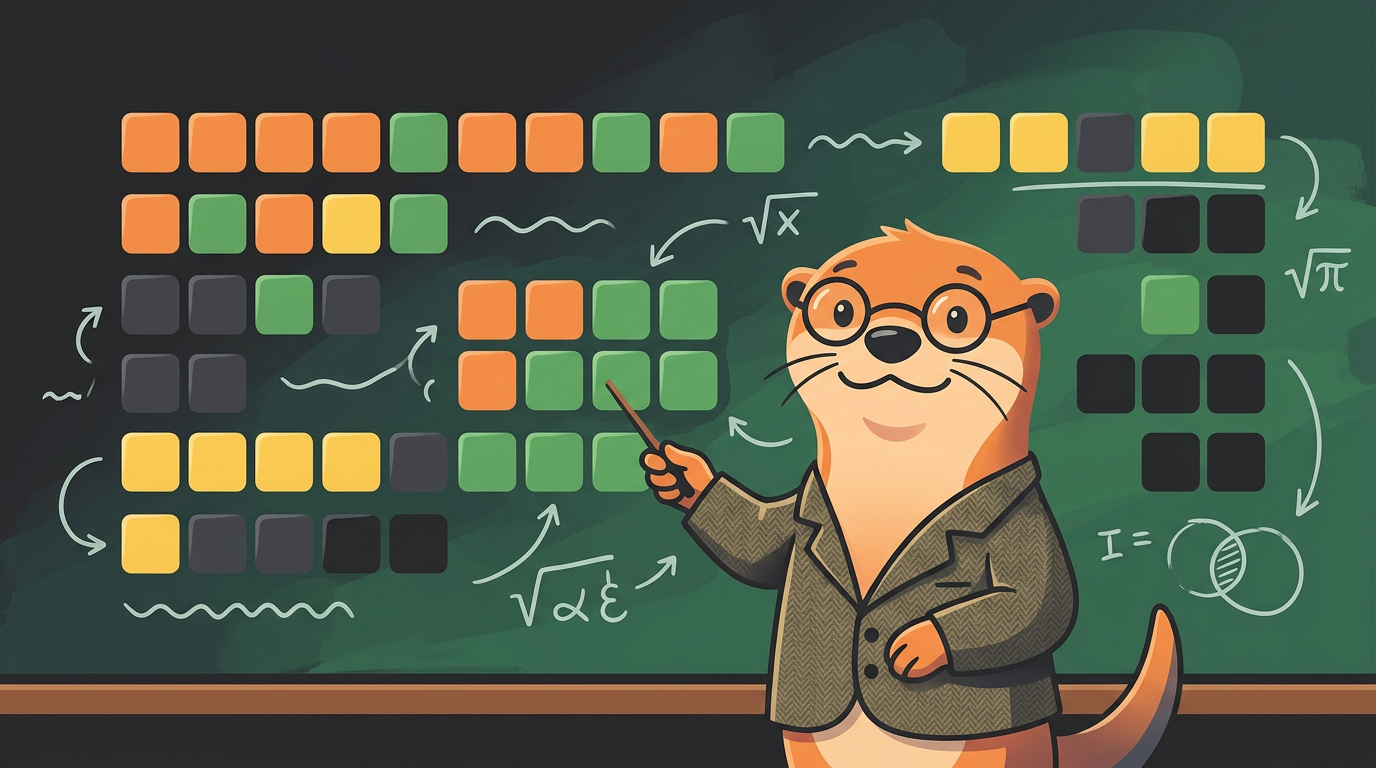
Instead of aiming for a lucky guess, the researchers built a framework powered by Shannon entropy—a concept from information theory that measures uncertainty. The goal of an entropy-driven strategy isn't to guess correctly on turn two or three. The goal is to maximize information gain.
When applying this strategy, the computer system evaluates all possible remaining options and selects a guess that incinerates as much uncertainty as humanly (or algorithmically) possible.
Here is where it gets wonderfully weird: to gather the maximum amount of data, the math frequently recommends guessing a word that has zero chance of being the daily target answer.
By throwing away a turn on a bizarre, consonant-heavy word that couldn't possibly be correct, you test four or five entirely new letters at once. You might get five gray tiles back, but in the world of information theory, five grays is a massive victory. You've just eliminated dozens of potential words in a single stroke, dramatically shrinking the pool of remaining possibilities.
When the researchers ran simulations using this entropy-maximizing approach, the system solved a staggering 99 percent of Wordle puzzles within the six-guess limit.
The Otterly Interesting Part
What makes this discovery so delightful is how much it contrasts with human psychology. As humans, we love the quick dopamine hit of guessing the word early. Typing in a word you know is wrong feels counterintuitive and a little embarrassing—especially if anyone is watching over your shoulder.
We play defensively, trying to preserve our partial matches. Math, on the other hand, plays like a chaos agent with a master's degree. It doesn't care about looking clever on line two; it only cares about absolute certainty by line four or five.
How to Outsmart the Group Chat
While doing complex logarithmic probability calculations in your head while sipping morning coffee might not be super practical, taking a lesson from information theory absolutely is.
Next time you are stuck in Wordle limbo with a couple of confusing yellow tiles, resist the urge to immediately hunt for the right answer. Instead, channel your inner information theorist. Throw out a wild, information-packed guess that tests brand-new letters, narrow down the field, and watch your win rate soar.
Your friends might think your second guess looks completely unhinged, but they won't be arguing when you post a perfect win record week after week.
Keep exploring
- Proof That Even a T. Rex Couldn't Sneak Past a Science Teacher
- Is Your Cat Being Rude, or Are They Secretly Obsessed With You?
- How to Zipline Into Godzilla’s Mouth and Look Stunning Doing It
- Take an Otter quiz
Join the conversation
Join the conversation
Kind, funny and useful takes only — that's the otter way.
Loading comments…