Why Your Grandma and Your Teenager Are Using the Exact Same Words to Mean Opposite Things
From holiday dinner miscommunications to words that completely flip their definitions, here is the fascinating science of how language shapeshifts under our noses.
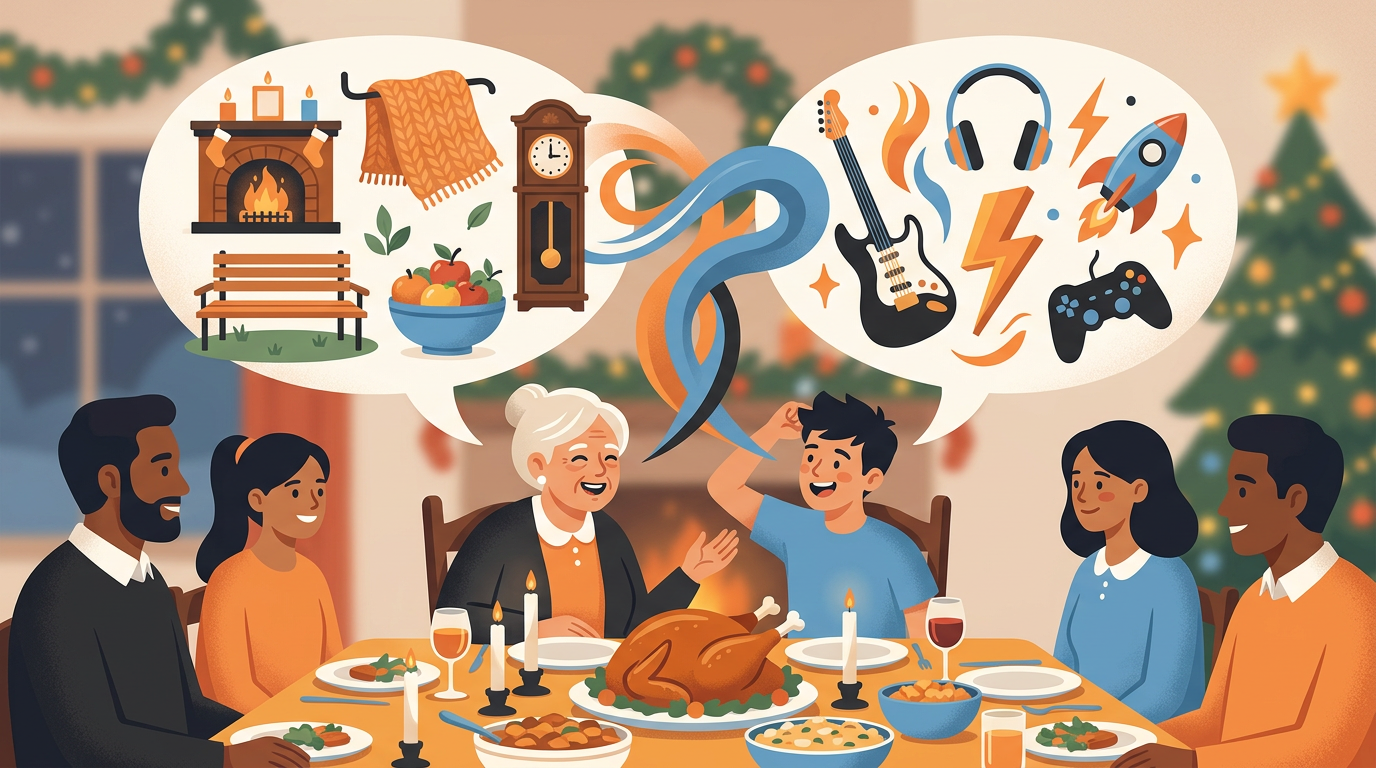
Imagine sitting at the holiday dinner table. Your grandmother passes the mashed potatoes and remarks that the weather outside is awful. Five minutes later, your teenage cousin digs into a second serving of pie and declares that it is sick. Both generations are using English, yet if an alien were translating the conversation, they would assume everyone at the table was having a mildly traumatic experience.
Welcome to the world of semantic change—the formal term for the quiet, constant shapeshifting of word meanings over time. We like to think of the dictionary as a carved marble tablet, but language is actually more like a messy group project. Words are constantly changing their jobs, taking on new side hustles, or abandoning their original definitions entirely.
How Words Change Behind Our Backs
Language evolution does not start in a smoke-filled room of dictionary editors. It almost always begins inside small speech communities—think tight-knit high school friend groups, specialized work crews, or online subcultures. Someone uses a word in a slightly weird, creative way, their friends catch on, and eventually, the new meaning escapes into the wild.
Linguists break this shapeshifting down into five main mechanisms that interact continuously every time we converse:
1. Extension: A word broadens its horizons. For instance, an old term for a specific hound eventually expanded to cover every barking quadruped on the planet.
2. Reduction: The opposite happens, and a word gets hyper-specific. Meat originally referred to any solid food at all before narrowing down exclusively to animal flesh.
3. Elevation: A word gets a social promotion. Nice started out in Middle English meaning ignorant or foolish. Over centuries of linguistic gymnastics, it climbed the ladder until it became a polite compliment.
4. Pejoration: A word takes a slide into negativity. Centuries ago, silly meant blessed, pious, or innocent. Over time, being innocent got associated with being harmless, then weak, and finally foolish.
5. Intensification: We dial up the drama. Words that originally described overwhelming terror get recycled as everyday hyperbolic amplifiers—which is how terrible and awful became standard ways to describe lukewarm soup.
The Otterly Interesting Part
Here is the wild thing about language: once a word shift becomes ubiquitous, speakers usually forget that the word ever possessed a different original meaning. Nobody eats a delicious meal and thinks about ancient broad terms for food, nor do we pause at a wedding to congratulate the foolish couple when we call them nice. The old definitions simply dissolve into historical trivia, leaving us entirely convinced that our current version of the word is the only one that ever made sense.
So the next time dinner table chatter turns into a cross-generational translation exercise, do not worry. Language is not broken—it is just doing what it has done for thousands of years: refusing to sit still.
What is a word you have noticed shifting meanings in your own family conversations?
Keep exploring
- Johnny Appleseed Wasn't a Barefoot Vagrant—He Was a Frontier Cider Genius
- That Time the Australian Military Lost a War to Flightless Birds
- Welcome to the Jungle-Snake: Why Scientists Named a Toothy New Reptile After Slash
- Take an Otter quiz
Have something to add?
Join the conversation
Kind, funny and useful takes only — that's the otter way.
Loading comments…