
This Tiny Spider Hangs Upside Down and Twitches Like a Sleeping Puppy
Researchers discovered that Australian jumping spiders experience REM-like sleep, complete with flickering eyes and twitching legs.
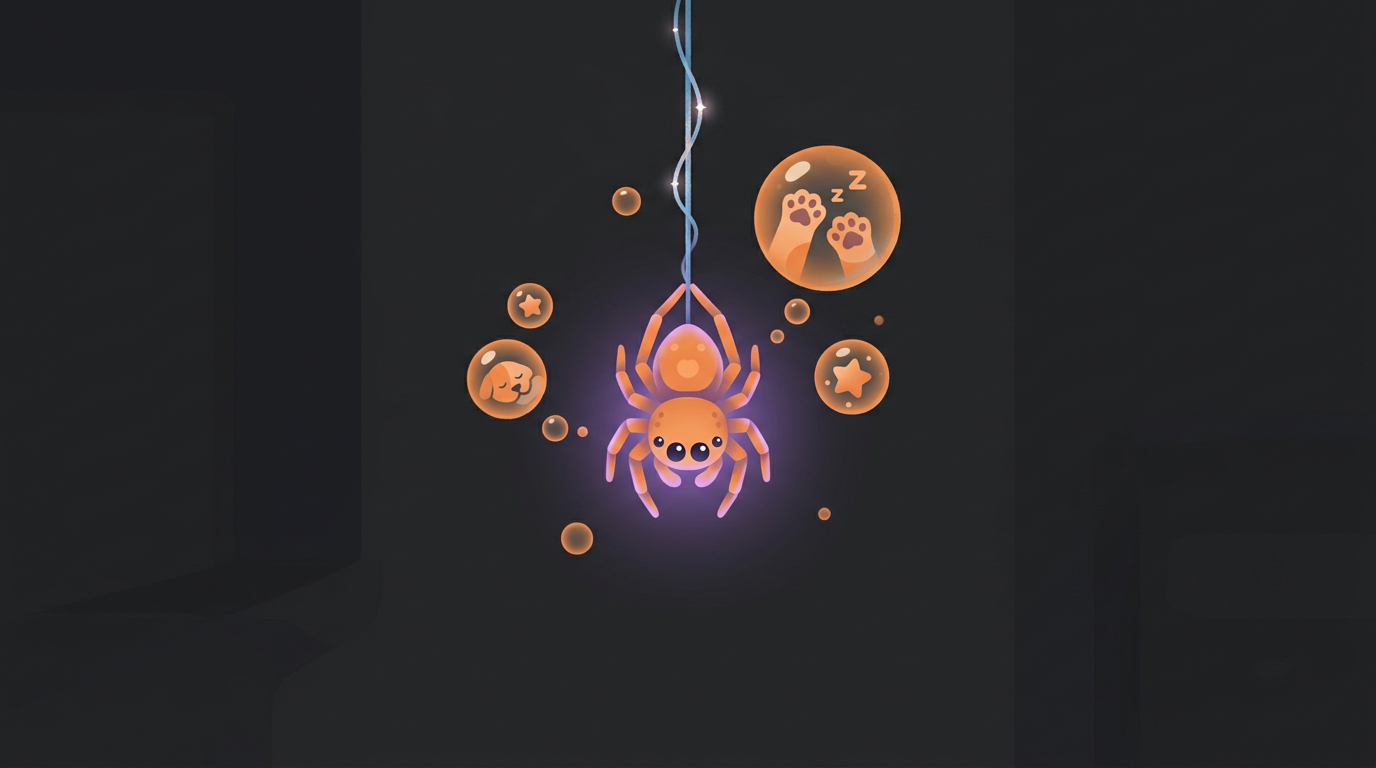
If you have a dog or a cat, you’ve probably spent a few minutes giggling at their sleep habits. The tiny paws running toward invisible squirrels, the muffled woofs, the rapid eye movement under closed lids. It’s adorable. But what if I told you that tiny, eight-legged arachnids might be doing the exact same thing while suspended upside down in the dark?
High-Stakes Day Jobs
Meet Portia fimbriata, an Australian jumping spider about the size of a one-euro coin. By day, this little creature is essentially a master of psychological warfare. Instead of building standard webs to catch flies, Portia hunts other spiders. And it doesn't just pounce; it tricks them.
Portia will gently pluck the strands of another spider’s web, perfectly mimicking the vibration patterns of a trapped insect. When the unsuspecting web-owner comes bustling out to collect dinner, Portia drops the ambush. It takes serious focus, strategy, and patience for a creature that small.
The Upside-Down Bedtime Routine
So how does a tiny trickster unwind after a hard day of web-based catfishing? Researchers decided to find out using 12-centimeter plastic dishes and night-vision infrared cameras. Because visible light would disturb the spiders, infrared technology was essential to observe their micro-movements in total darkness.
When bedtime arrives, Portia spins a single strand of silk, attaches itself, and hangs upside down in mid-air. It is the ultimate tiny hammock setup. Once comfortably suspended, the spider enters a deep rest, showing two distinct sleep stages.
Twitchy Legs and Flickering Eyes
During one of these stages, scientists observed something remarkable: the spider’s legs began to twitch, and its retinal tubes—the internal structures that move its eyes—started flickering rhythmically. In vertebrates, this kind of rapid eye movement and muscle twitching is the classic signature of REM sleep.
The Otterly Interesting Part
Now, science hasn't proven that these spiders actually experience subjective, vivid dreams the way humans or dogs do. We also don't know for sure if arachnid sleep shares a direct evolutionary lineage with our own brain waves. But imagining the possibilities is half the fun! Is little Portia reliving its greatest web-tugging moments from the afternoon? Is it having a tiny night terror about a giant bird? Or is it just resting up for tomorrow's big hunt?
Whether Portia is dreaming of epic spider tricks or just catching rest, knowing that tiny spiders hang from invisible hammocks and twitch their legs in the dark makes the world feel just a little more wondrous.
Keep exploring
- How a Williamsburg Rescue Pigeon Swapped the Sidewalk for a Designer Tote
- Why Mother Nature Gave Wombats Square Poop (And Why It’s Pure Genius)
- Move Over, Sopranos: The Met’s Quietest Diva Has Four Legs and Hooves
- Take an Otter quiz
Join the conversation
Join the conversation
Kind, funny and useful takes only — that's the otter way.
Loading comments…