Meet the 'Sea Muppets': Nature’s Cutest Case of Copy-Paste Evolution
Scientists just uncovered a trio of rare deep-sea fish that look like seahorses, act like seahorses, but spent decades pulling off a cosmic trick in museum archives.
If you’ve ever felt like copy-pasting your way through a project at work, take comfort in the fact that nature does it all the time. Case in point: a newly identified family of deep-sea creatures affectionately dubbed "sea muppets."
For decades, scientists thought these tiny aquatic oddballs were just unusual seahorses. But after a little modern sleuthing, researchers realized that evolution hit copy-paste on the seahorse design, producing a completely distinct branch of fish that independently developed the exact same look. And the best part? They’ve been pulling off this grand optical illusion right under our noses inside museum storage cabinets.
The Ultimate Deep-Sea Tricksters
The genus was officially named Australyichthys—a combination of the Latin word for southern and the Greek word for fish. It consists of three delightfully weird species: the helmethead sea muppet (A. aegis), the bullneck sea muppet (A. minotaur), and the paradoxical sea muppet (A. paradoxus).
Here is how rare these little guys are: across 65 years of marine exploration, only seven specimens have ever been collected. Zero have been documented alive. Every single known specimen was gathered by accident in trawls or dredges between 50 and 125 meters deep off the coast of southern Australia.
When scientists finally put them through high-tech micro-CT scans, the illusion crumbled. Unlike true seahorses, sea muppets lack the characteristic fused belly cage plates and head coronet. Yet, in one of nature's funniest twists, male sea muppets still feature a fully enclosed pouch for brooding their babies. They went to all the trouble of building the custom baby backpack without being true seahorses at all.
Misfiled in the Invertebrate Drawer
So how did a totally new lineage of ocean critters hide from science for so long? By being in the wrong filing cabinet.
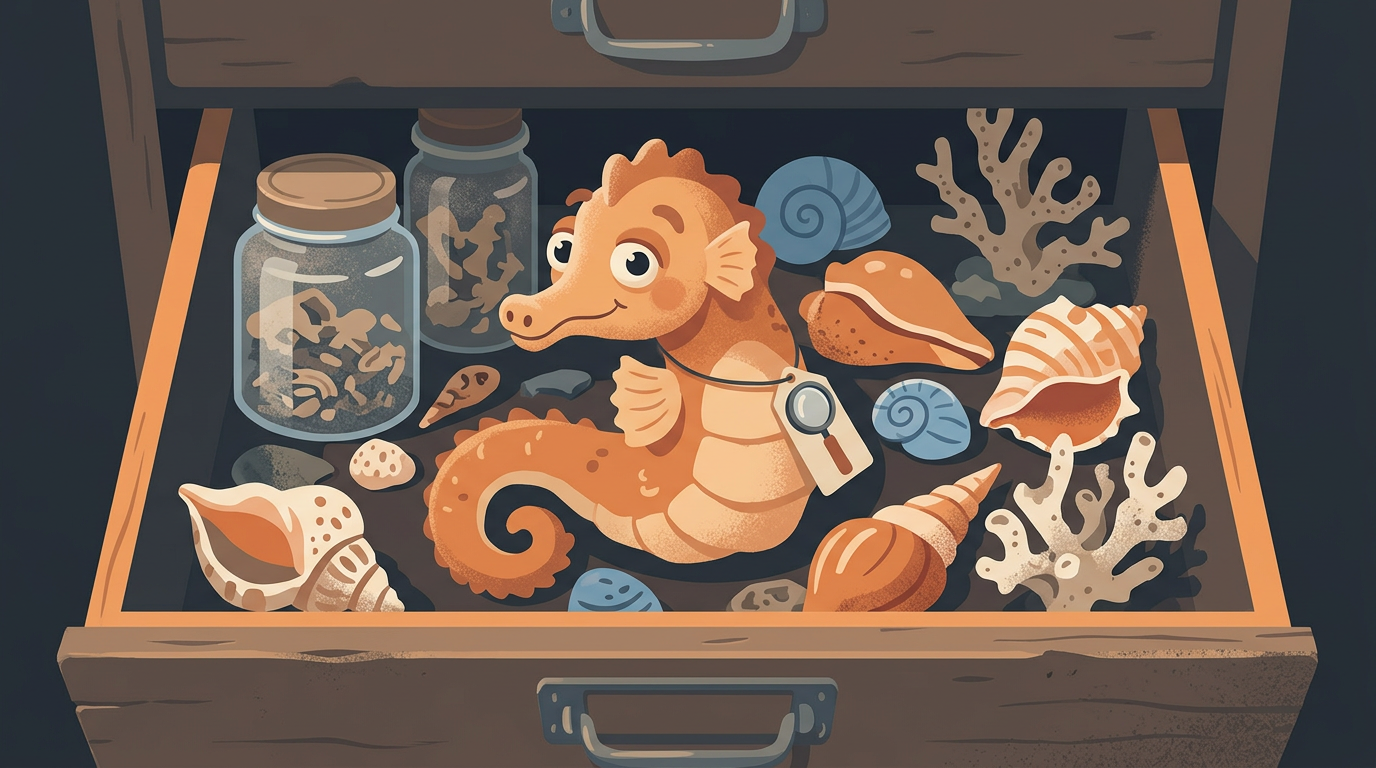
One specimen of A. aegis spent years sitting unnoticed in an invertebrate collection. Why? Because it was originally dragged up during an ocean expedition searching for shelled brachiopods. Someone took a look at the bizarre little hitchhiker, shoved it into a jar, and cataloged it alongside ocean clams.
Luckily, that specific specimen was preserved in ethanol rather than formalin. That single choice allowed scientists to extract intact DNA and sequence its genetics. The results confirmed that while sea muppets are close cousins to seahorses, they represent a distinct evolutionary line that took its own detour into the deep blue.
The Otterly Interesting Part
This is a classic example of convergent evolution—when two completely different creatures arrive at the exact same physical blueprint because it just plain works. Nature found a design so charming and efficient that it used it twice. It’s like discovering that two totally unrelated artists accidentally painted the exact same portrait of a sea horse, except one of them was secretly a muppet the whole time.
A Deep-Sea Mystery Left Unsolved
Because no live specimen has ever been observed in the wild, we still don't know what a sea muppet looks like when it's going about its day-to-day business. Do they bob around lazily? Do they hang out in underwater gardens? We can only guess.
What we do know is that the ocean—and dusty museum drawers—are still packed with secrets waiting for someone to open the right jar. So next time you're cleaning out your storage closet, keep your eyes peeled. You might not find a sea muppet, but you have to admire a creature clever enough to play hide-and-seek for over half a century.
Keep exploring
- Need to Memorize Something Fast? Try Turning Your Living Room into a Crime Scene
- Under UV Light, Europe’s Most Toxic Salamander Is Basically a Walking Glow Stick
- Lesson Plans for Donkeys: Why Morning Snuggles Are Step One of Farm Training
- Take an Otter quiz
Join the conversation
Join the conversation
Kind, funny and useful takes only — that's the otter way.
Loading comments…