
Scientists Accidentally Invented the World's Most Expensive Deep-Sea Cat Toy
When researchers sent a high-tech sub 323 meters off the coast of Hawaii, they expected marine data—not an eight-armed creature acting just like a housecat with a laser pointer.
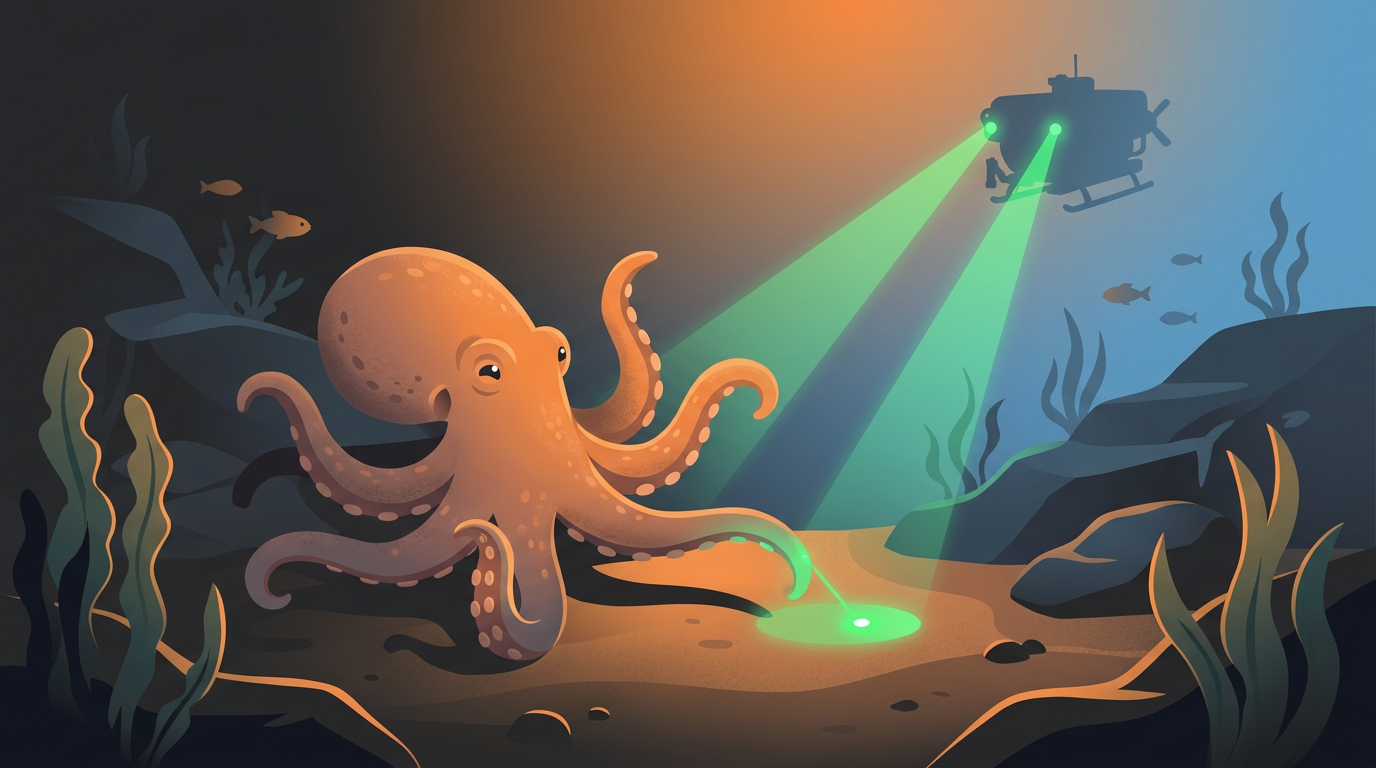
Picture this: a team spends years building high-tech underwater equipment, launches a state-of-the-art research vessel, and lowers a remote-operated vehicle hundreds of meters into the dark ocean depths. The mission? Uncover the mysteries of the marine ecosystem. The result? Accidentally creating the universe's most expensive cat toy.
That is pretty much what happened off the coast of Hawaii in the Papahānaumokuākea National Marine Sanctuary. While exploring St. Rogatien Bank at a depth of 323 meters, an underwater exploration crew stumbled upon a sight that felt delightfully familiar to anyone who has ever owned a housecat.
The High-Tech Laser Pointer
The sub at the center of this ocean show was the remotely operated vehicle Hercules, deployed from the research vessel E/V Nautilus. Hercules is equipped with green scaling lasers. Oceanographers routinely use these twin parallel beams as a high-tech underwater ruler to measure the actual size of sea creatures and geological formations on camera, since judging scale in the open ocean can be tricky.
Usually, marine life either ignores the green dots or casually swims away. But as Hercules hovered near the seafloor, one curious octopus had a completely different plan.
When Eight Arms Chase One Green Dot
Instead of hiding or ignoring the strange light, the octopus fixated on the bright green dot dancing across the ocean floor. It began actively pursuing the laser light, gliding across the seafloor and reaching out toward the glowing spot in a way that looked suspiciously like a kitten pouncing on a living room rug.
The researchers watching the feed couldn't hide their surprise. While octopuses are famous for their remarkable intelligence and problem-solving skills, seeing one actively chase a laser dot at a depth of over 1,000 feet is an extraordinarily rare sight.
Curiosity, Instinct, or Twilight Zone Magic?
Why did the octopus react this way? Science is keeping an open mind. We can't say for certain whether the creature was expressing playful curiosity or simply following a hardwired predatory instinct to catch what looked like tiny glowing prey.
However, the observation raises fascinating questions about vision in the ocean's twilight zone—the dimly lit layer of sea between the sunlit surface and the pitch-black abyss. Scientists note that species living in this middle depth may possess unique visual traits and behavioral responses distinct from their deeper abyssal relatives, who live in complete darkness.
Whether all twilight-zone cephalopods share an obsession with glowing dots remains to be seen, but this particular encounter showed just how inquisitive deep-sea animals can be.
The Otterly Interesting Part
It turns out curiosity might just be a universal constant across the animal kingdom. Whether a creature has four furry paws or eight suction-cup-covered arms, a mysterious, fast-moving glowing dot on the floor seems to trigger the exact same response: I must catch the dot.
Next time you're entertaining your domestic feline with a five-dollar laser pointer, just remember that somewhere hundreds of meters beneath the waves, a deep-sea octopus is living out the exact same drama.
Keep exploring
- Your Heavy Childhood Backpack Might Have Been Secret Superhero Training
- Before 1977, Celebrations Were Awkward: The True Origin of the High-Five
- You Cannot Hide From a Four-Ton Best Friend, but This Caretaker Still Tried
- Take an Otter quiz
Otterly agree? Tell us why.
Join the conversation
Kind, funny and useful takes only — that's the otter way.
Loading comments…