
What If Your Next Space Snack Was Made from Yesterday's Soda Bottle?
Scientists have engineered baker's yeast to transform plastic trash into edible, vanilla-flavored 3D-printed cookies.
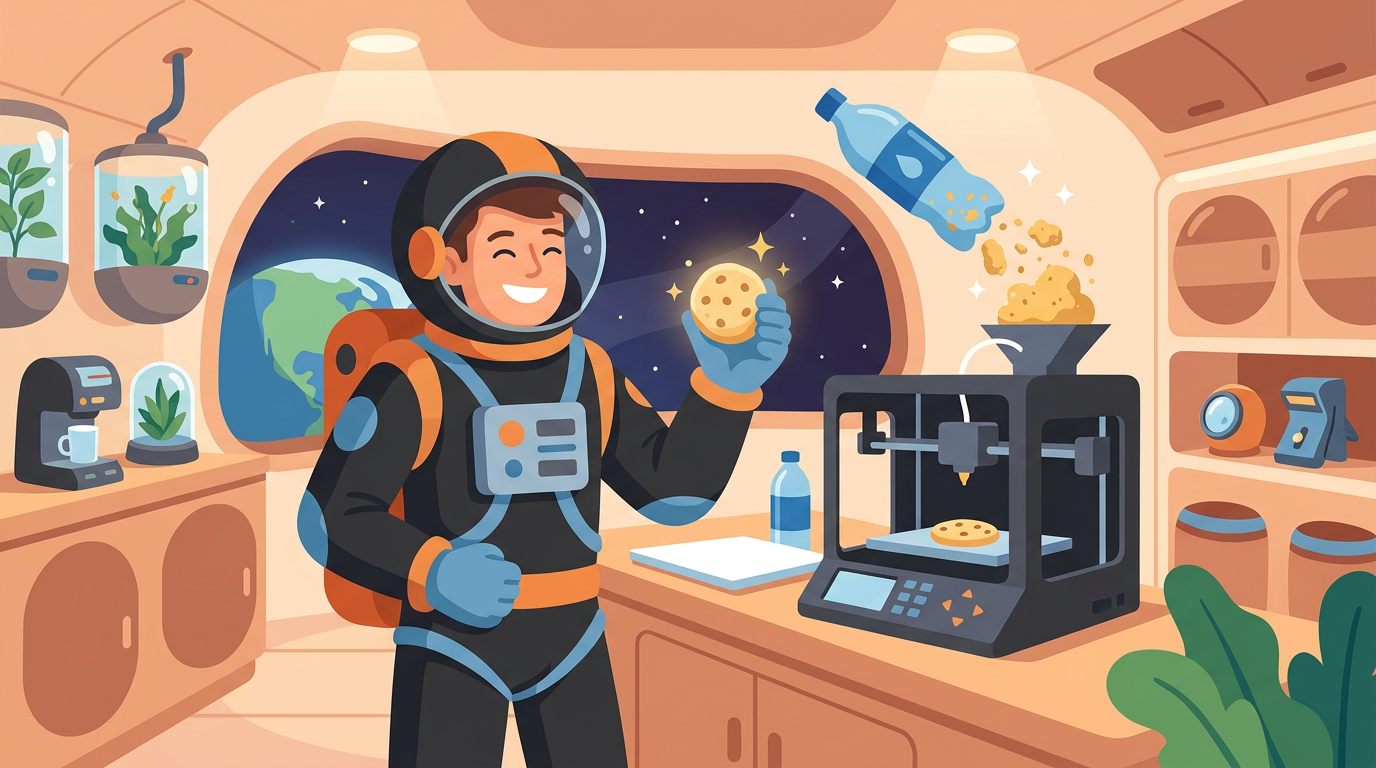
Imagine holding an empty plastic soda bottle and thinking, "You know what? This would make a fantastic vanilla cookie."
Unless you have a deeply unusual relationship with kitchen prep, that thought has probably never crossed your mind. But for a team of inventive researchers, it was the spark behind one of the wildest culinary experiments in recent memory: turning synthetic waste into edible, nutrient-dense food.
Developed in part for NASA's Deep Space Food Challenge, this project takes everyday PET plastic bottles and agricultural waste and converts them into protein-rich, 3D-printed treats called µBites.
The Carbon Connection
The idea started with a strikingly simple realization by lead researcher Lahiru Jayakody: at a molecular level, both plastic garbage and human food are fundamentally built out of carbon. Plastic is essentially just long chains of carbon waiting to be rearranged.
So why not rearrange them into dinner?
To make the transformation work, the research team relied on a process called oxidative hydrothermal dissolution, developed by Professor Ken Anderson. In plain English: they take raw plastic waste and agricultural scrap, subject them to water and oxygen under specific conditions, and break the stubborn materials down into a liquid soup of simple organic compounds.
Enter the Super-Yeast
Once the plastic is broken down into a liquid base, the secret ingredient takes over: genetically engineered yeast.
Researchers modified strains of yeast—including standard baker's yeast—to feast directly on that processed carbon liquid. As the yeast digests the broken-down waste, it produces essential proteins, healthy fats, and vital vitamins. And because no dessert is complete without a little aromatic charm, the system can even synthesize natural vanilla flavoring directly from the processed trash.
The resulting nutritious biomass is then loaded into a 3D printer, which extrudes precise, bite-sized snacks known as µBites.
Where Are We Eating Trash Cookies?
Before you start hunting for plastic-derived snacks in the grocery aisle, this technology is being designed for very specific, high-stakes environments.
NASA envisions using these systems on long-duration space missions, where resupply ships aren't an option and every bit of waste must be reused. Beyond deep space, the technology could provide crucial emergency sustenance aboard submarines or in remote disaster zones where traditional food supply chains have completely collapsed.
Of course, whether astronauts or disaster survivors will actually enjoy relying on plastic-derived cookies for long-term meals remains an open question. But as a technical proof of concept, it is a staggering step forward.
The Otterly Interesting Part
There is something wonderfully poetic about the fact that baker's yeast—the exact same microorganism humans have used for thousands of years to bake bread and brew beer—is now being re-engineered to eat our modern plastic garbage. It is the ultimate crossover between ancient culinary tradition and sci-fi recycling technology.
So, if you were offered a freshly printed, vanilla-flavored µBite straight out of a space printer... would you take a bite?
Keep exploring
- A Man Searched 20 Years for His Birth Mother. ChatGPT Solved It with Four Clues.
- How to Recreate the Acoustic Symphony of a 1990s Back-to-School Season
- A Boomer Opened a Low-Tech Storefront to Teach AI. The Internet Roasted Him, Then Fell in Love.
- Take an Otter quiz
Join the conversation
Join the conversation
Kind, funny and useful takes only — that's the otter way.
Loading comments…