The Secret Math of Chemistry: How to Hit the Conversational Goldilocks Zone
Researchers mapped thousands of dialogues and uncovered the secret rhythm of sparky banter—plus how to escape the dreaded polite echo chamber.
We have all been trapped on that one date. You know the one: on paper, you two should be planning your joint retirement in Tuscany. You both love dogs, appreciate sourdough, and harbor mild disdain for people who walk too slowly on sidewalks.
Yet, five minutes into drinks, speaking to them feels like pushing a grand piano up a muddy hill. Every exchange lands with a dull thud.
Then, thirty minutes later, you strike up an effortless twenty-minute riff with the bartender about 1990s snack foods. Sparks fly, jokes land, time bends. What gives?
For decades, conventional wisdom insisted that interpersonal chemistry is all about similarity. If your Venn diagrams overlap enough, the magic just happens. But a team of curious psychologists at Dartmouth College decided to look past what we say and analyze the invisible acoustic physics of how we talk.
By crunching data from thousands of real-world dialogues—including strangers, longtime friends, podcast hosts, and brave souls speed-dating for science—they discovered that real chemistry isn't a personality checklist. It is a very specific, dynamic rhythm.
The Three Flavors of Conversational Noise
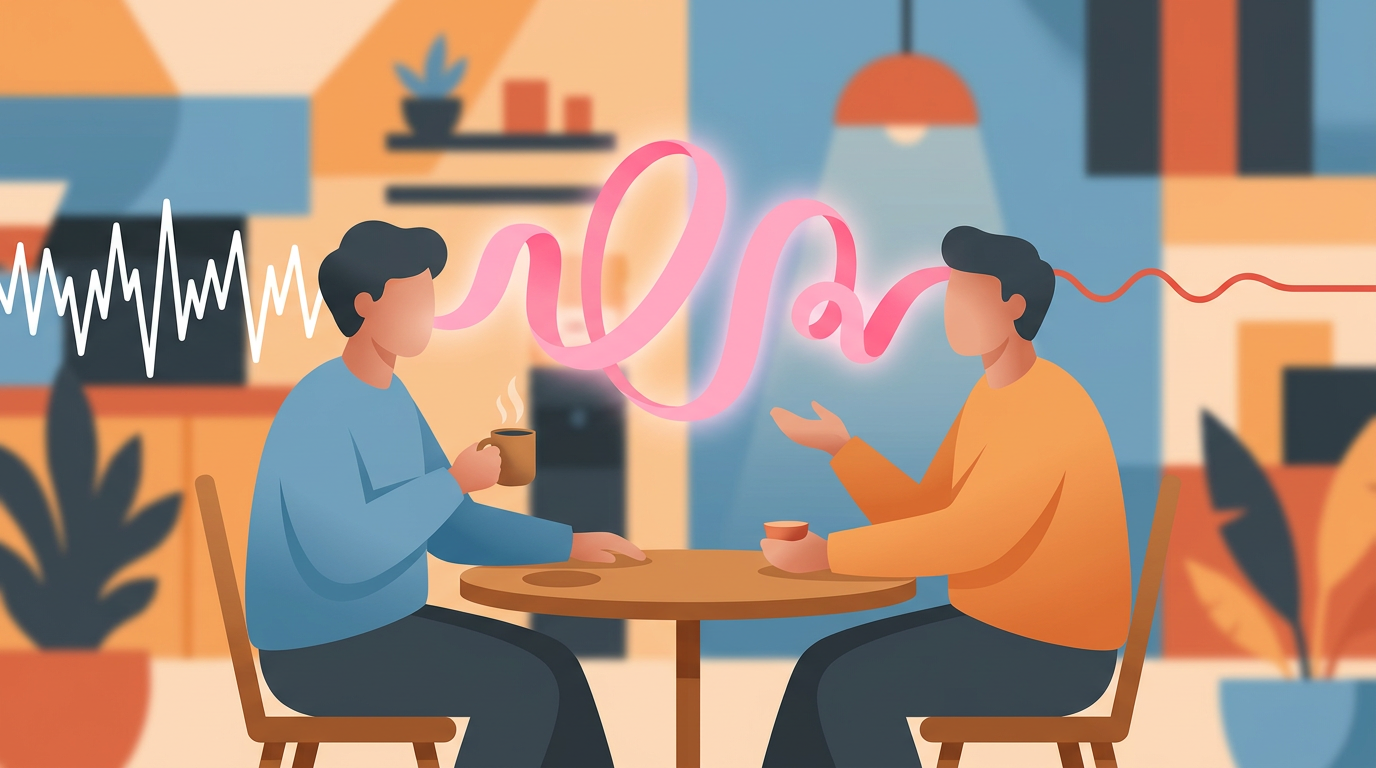
To make sense of how dialogue ebbs and flows, the researchers borrowed concepts straight out of audio engineering. As it turns out, human interactions generally fall into three distinct acoustic patterns:
White Noise (The Chaos Spiral): This is the conversational equivalent of television static. One person mentions they just adopted a rescue terrier, and the other immediately pivots to their thoughts on medieval catapult designs. There is zero continuity, no shared thread, and no rhythm. It feels jittery, exhausting, and slightly confusing, like trying to play tennis with someone who keeps swatting the ball into the parking lot.
Red Noise (The Polite Prison): Also known in signal processing as brown noise, this is where banter goes to die of boredom. Red noise happens when two people get stuck in an endless loop of polite agreement. "I love tacos." "Oh, me too, tacos are so good." "Totally. Especially with lime." "Yes, lime is classic." It feels safe, but there is zero momentum. Red noise also applies to the opposite extreme: two people stubbornly entrenched in opposing camps, endlessly repeating their positions without moving an inch.
Pink Noise (The Goldilocks Zone): Here is where the magic lives. In nature, pink noise balances unpredictable surprises with predictable patterns—think of the soothing yet ever-shifting sound of ocean waves or rain on a tin roof. In conversation, it means you and your partner are constantly alternating between finding common ground and lobbing in surprising new angles.
You build on their point, veer slightly off course, tether it back to something shared, and bounce forward. It is not total agreement, and it is not total chaos. It is a dance.
Why Your Brain Craves the Bounce
The Dartmouth team found that dialogues rich in this balanced pink noise rhythm scored through the roof in participant ratings of personal connection, genuine enjoyment, and engagement. Even better? People remembered these conversations far more clearly days later.
Crucially, having identical backgrounds or matching opinions didn’t guarantee this rhythm. Two people with wildly divergent worldviews could generate incredible pink noise just by actively batting ideas back and forth, while two near-clones could easily suffocate in a bog of red-noise pleasantries.
The Otterly Interesting Part
There is a comforting revelation hidden in the math here: chemistry is not an innate, mystical trait that you either possess or lack. It is a collaborative tempo.
That said, the scientists note that you cannot really "game" or fake pink noise like some cheap pick-up trick. Rhythmic conversation requires actual listening, because the entire phenomenon hinges on responding to subtle micro-cues in real time.
How to Ditch the Script
While you cannot force instant chemistry out of thin air, you can definitely diagnose why a conversation is stalling out out and give it some room to breathe.
Next time you find yourself stuck in a looping red-noise rut—trading harmless, echoing agreements about the weather or local traffic—resist the urge to just nod and agree one more time. Introduce a little novelty. Disagree playfully. Ask the weird question lurking at the back of your mind.
Chemistry isn't finding someone who agrees with everything you say. It's finding someone who knows how to keep the ball in the air.
Keep exploring
- This Tiny Wild West Town in Florida Is Run Entirely by Retired Senior Cats
- Why There’s a Terrifying Hollywood Alien Guarding an 800-Year-Old Scottish Abbey
- Before Giant Balloons Ruled Thanksgiving, Macy’s Paraded Live Zoo Animals Down Broadway
- Take an Otter quiz
What's your take?
Join the conversation
Kind, funny and useful takes only — that's the otter way.
Loading comments…