
That Time Charles Darwin Swore a Scottish Mountain Was a Beach Resort
Glen Roy’s eerie parallel terraces looked like ancient human roads, but the truth involved giant ice sheets, zero seashells, and twenty years of Charles Darwin being hilariously stubborn.
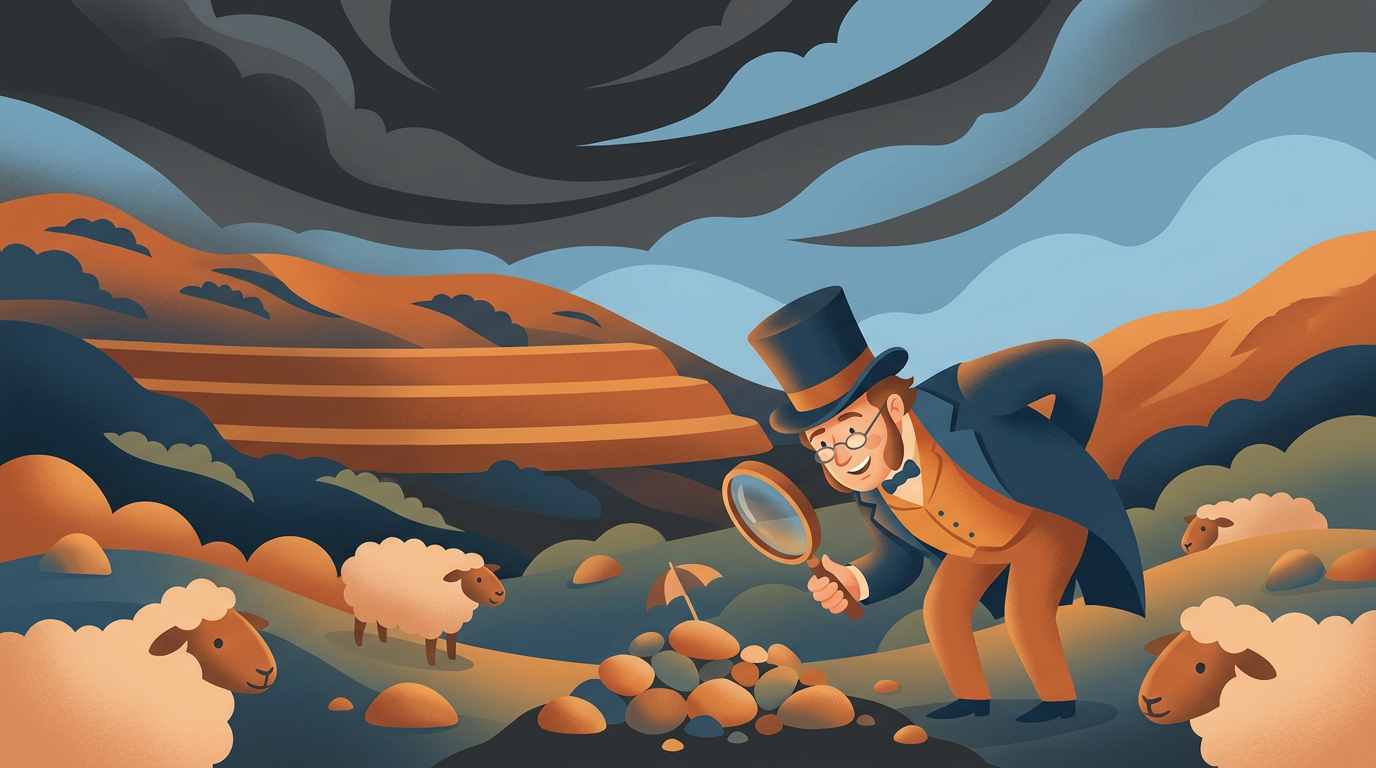
If you ever find yourself wandering through the moody, mist-draped Scottish Highlands about fifteen miles northeast of Ben Nevis, you might stumble upon Glen Roy and immediately think, "Wait, who paved three highways halfway up this mountain?"
Etched into the steep, heather-covered slopes are three strikingly level terraces running parallel to one another at roughly 260, 325, and 350 meters above sea level. They look so deliberate, so cleanly engineered, that for generations travelers assumed ancient kings or road-builders had carved them out. But there’s a slight logistical snag: two of the shelves sit a mere 25 meters apart vertically. Building two giant parallel highways stacked almost directly on top of each other across an empty Scottish hillside would be an act of sheer civil engineering madness.
Humans didn't build them. Nature did. And the battle over how they got there sucked in the greatest scientific mind of the Victorian era—leading to one of the most stubborn, charmingly misguided chapters of his life.
Enter Darwin, Armed With Confidence and No Seashells
Fresh off his legendary voyage on the HMS Beagle, a young, ambitious Charles Darwin arrived in Glen Roy in 1838. At the time, Darwin was intensely passionate about geology. He took one look at the three perfectly horizontal shelves winding around the valley and experienced a triumphant flash of inspiration: Beaches.
According to Darwin, the Scottish landmass must have slowly emerged from the ocean in steady stages. Each time the land paused its upward journey, restless ocean waves pounded the shoreline, cutting a neat shelf into the rock before the ground rose again. It was elegant. It fit his emerging worldview of gradual, uniform change across deep time.
There was just one tiny, awkward problem. Darwin couldn't find a single seashell. Not a clam, not an oyster, not a stray grain of marine sand along miles of supposed coastline. Darwin even noted this total absence in his journal, but he was so thoroughly enchanted by his marine hypothesis that he simply reasoned the evidence away, assuming centuries of Scottish weather had conveniently dissolved every last shell into thin air.
The Ice Age Crashes the Party
While Darwin was busy defending his shell-free seaside resort, Swiss naturalist Louis Agassiz showed up with a concept that sounded like absolute science fiction at the time: an Ice Age.
In the late 1830s, mainstream science favored the idea that bizarre northern landscapes were shaped by floating icebergs or catastrophic biblical deluges. Agassiz countered with something radical: what if vast continental sheets of solid ice had once smothered the land?
Agassiz looked at Glen Roy and saw something entirely different. Roughly 13,000 years ago, advancing valley glaciers acted like colossal frozen dams, choking off the glen's natural river drainage. Trapped behind this gargantuan wall of ice, meltwater pooled into a massive, deep lake. The lake lapped against the mountainside, carving out a beach along its water level. As the climate warmed and the glacial dam melted in distinct bursts, the lake drained in stages, each time pausing long enough to etch another shoreline into the rock. That explained why there were no seashells: it was a freshwater glacial bathtub.
The Otterly Interesting Part
It took over two decades for Darwin to finally throw in the towel. Even when other geologists began lining up behind the glacial dam explanation, Darwin defended his marine road trip well into the 1860s before finally conceding defeat around 1862.
He later called his Glen Roy paper one of his biggest scientific blunders. But here’s the wonderful truth about that mistake: it makes Darwin feel profoundly human. We tend to view historical geniuses as marble statues who simply opened their eyes and perceived the universe in high definition. The reality is far messier. Great science isn't about never guessing wrong; it's about following an idea to its absolute limit, taking your lumps when reality disagrees, and having the grace to eventually say, "Well, the ice guys were right."
A View Worth Being Wrong For
Today, the Parallel Roads of Glen Roy stand as a National Nature Reserve and an open-air monument to the power of ice—and the beauty of honest scientific debate. If you ever stand on the valley floor, watching those three phantom shorelines hug the contour of the hills, spare a gentle thought for Darwin. Because let's be honest: who among us hasn't stood in the pouring rain, squinted at an empty hillside, and stubbornly insisted we were at the beach?
Keep exploring
- How Helping a Buddy Look for a Lost Tool Made Two Men Millionaires
- Mother Nature Hates Rulers: The Billion-Dollar Quest to Put the Wiggles Back in a Florida River
- Your Untied Shoes Aren't Your Fault. Blame Seven Gs of Pure Kinetic Violence.
- Take an Otter quiz
Have something to add?
Join the conversation
Kind, funny and useful takes only — that's the otter way.
Loading comments…