
Scientists Put a 125-Million-Year-Old Crocodile Under a Blacklight and Found Its Secret Striped Wardrobe
A half-meter ancient croc relative sitting in a museum for over a century just revealed hidden tail patterns and early skin sensors under ultraviolet light.
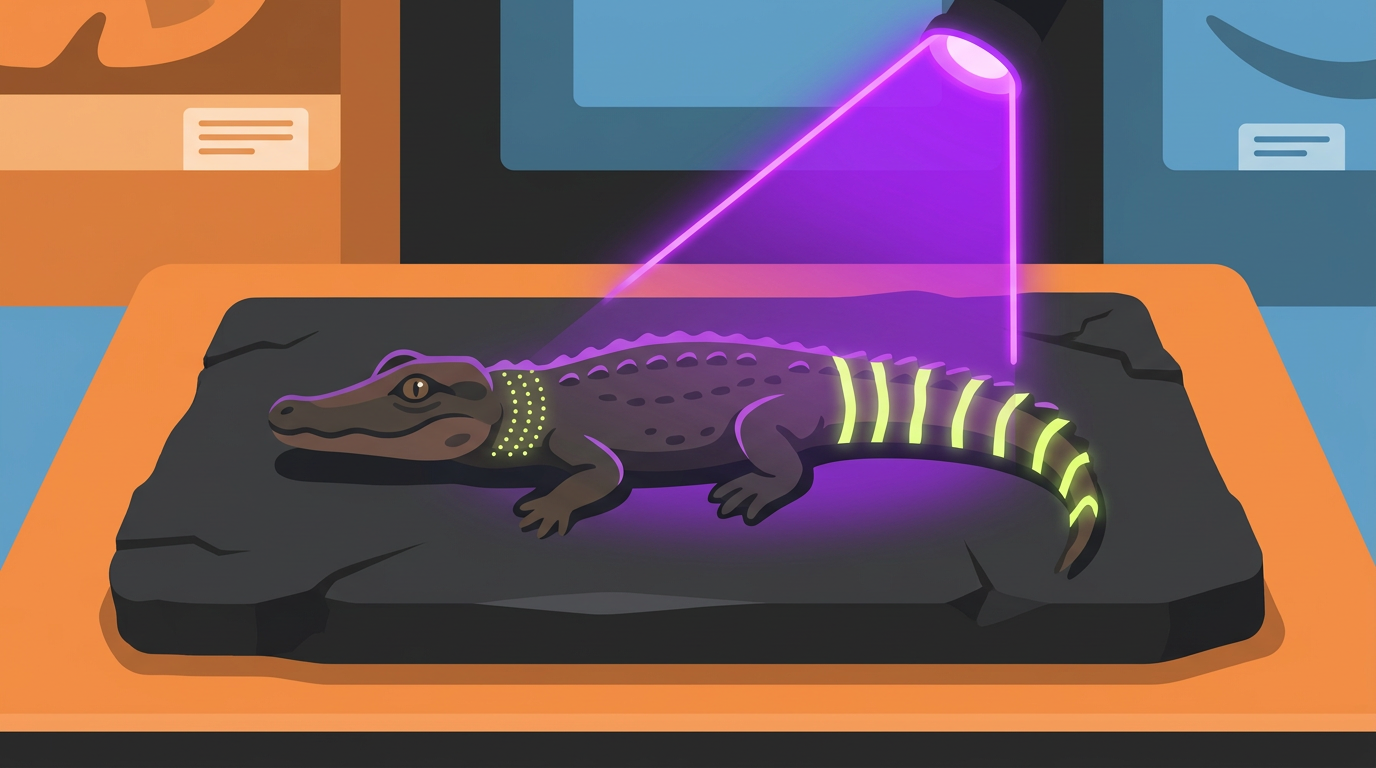
Imagine digging through your great-great-grandparent's attic and discovering they possessed a remarkably stylish, light-up outfit nobody knew about. That is essentially what just happened in the world of paleontology, except the relative in question is a 125-million-year-old crocodile cousin, and the light involved was ultraviolet.
For over a hundred years, a fossilized little reptile named Montsecosuchus depereti sat quietly in the collection of the Museum of Natural Sciences of Barcelona. Measuring roughly 50 centimeters long—about the size of a modern house cat—it was originally discovered in fine limestone sediments at the Pedrera de Meià site in Catalonia, Spain. To the naked eye, it looked like a standard, well-behaved ancient fossil. But when researchers brought out UV light to document it for a digital catalog, the specimen suddenly lit up with details no human had seen since the Early Cretaceous.
A Secret Pattern in the Shadows
Under the glow of blacklight, delicate soft tissue remnants invisible under normal lighting began to shine. Most strikingly, the UV illumination revealed a distinct pattern of alternating light and dark bands running along the creature's tail.
While researchers aren't declaring these stripes to be definitive functional camouflage just yet, the alternating tail pattern strongly hints at an evolutionary strategy for blending into the murky shadows of its ancient habitat. Back in its heyday, this little reptile died in a coastal karstic lake, where exceptionally fine silt settled around its body, locking its delicate skin details in amber-like perfection for tens of millions of years.
Interestingly, the analysis also showed that Montsecosuchus depereti lacked the tall, paddle-like tail fin that modern alligators and crocodiles use to propel themselves like underwater torpedoes. Instead, this creature was likely cruising through shallower waters with a somewhat different swimming style.
Prehistoric Early Warning Systems
Tail fashion wasn't the only surprise hidden in the scales. The ultraviolet light also highlighted microscopic, sensory-like structures clustered along the boundary scales of its neck, limbs, and the sides of its tail.
Modern crocodiles are famous for having tiny sensory organs dotted across their skin that detect water ripples, pressure changes, and movement. Finding these structures isolated to specific patches on this 125-million-year-old specimen suggests that crocodilian skin sensors didn't appear all at once across the whole body. Instead, they likely started in small, strategic hotspots before expanding into the full-body surveillance system today's gators carry around.
The Otterly Interesting Part
There is something wonderfully humbling about the fact that this specimen sat on a museum shelf for over a century before sharing its biggest secrets. It wasn't tucked away in a remote desert or buried under tons of fresh rock—it was sitting right there in a display drawer, waiting for someone to look at it with a different frequency of light.
It makes you wonder: how many other ancient creatures sitting quietly in glass cases right now are just waiting for the right glow to reveal their hidden stories? If you happen to have a blacklight handy on your next museum trip, maybe keep an eye out for prehistoric high fashion.
Keep exploring
- NASA’s Next Big Telescope Is Built Like the Ultimate Cosmic Road-Tripper
- Agatha Christie Sold Two Billion Books—and Still Cringed at Some of Them
- Forget Smelling Salts: Why Sniffing Cocoa Could Supercharge Your Workout
- Take an Otter quiz
Join the conversation
Join the conversation
Kind, funny and useful takes only — that's the otter way.
Loading comments…