
What 54 Roman Emperors Actually Looked Like (Minus the Marble)
A designer combined ancient marble busts, historical age records, and digital tools to give Rome's rulers realistic human faces.
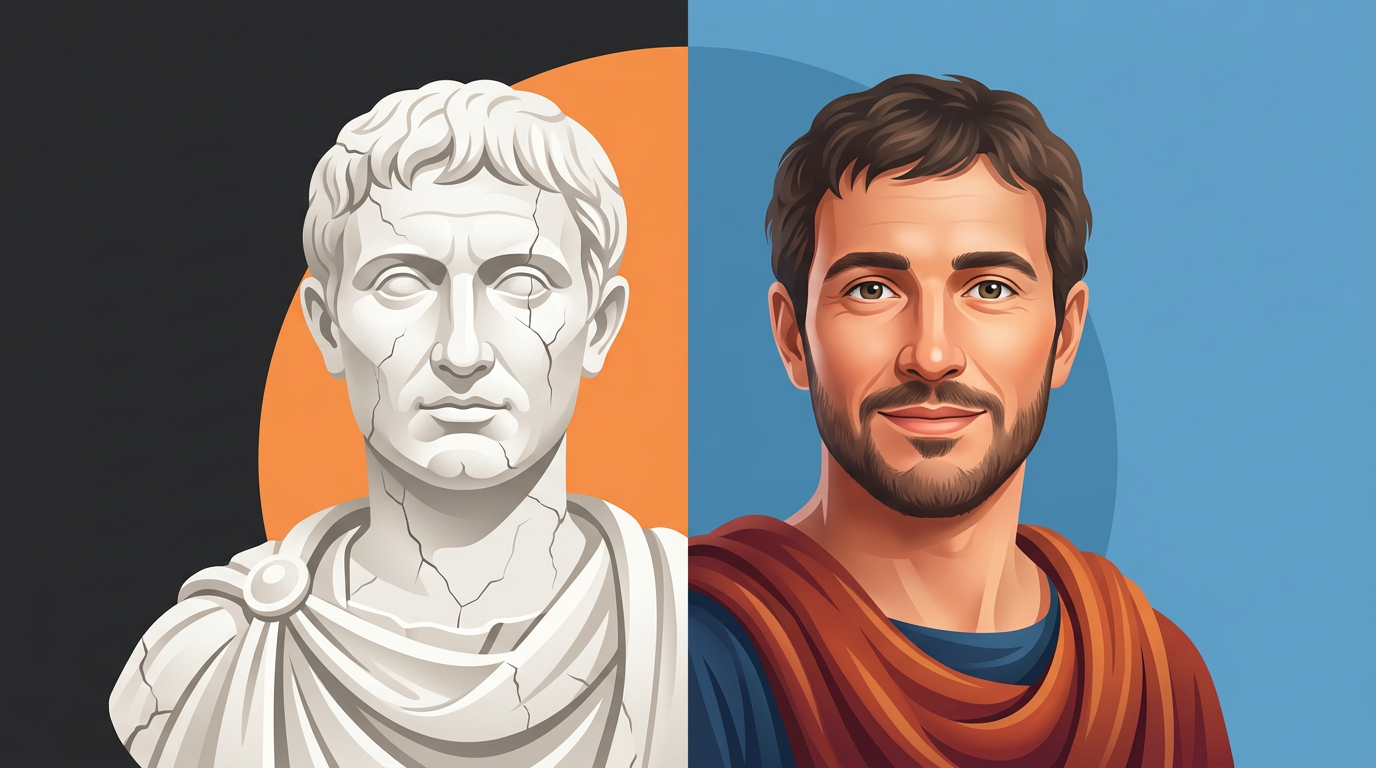
When you picture a Roman emperor, your brain probably defaults to a cold, blank-eyed marble statue staring sternly into the middle distance. It is easy to forget that beneath all that pristine white stone were actual human beings with skin tones, hair textures, and very real stress lines.
Thanks to a fascinating digital art effort, those ancient stone faces have been given a remarkably lifelike makeover.
Stripping Away the Ancient Photoshop
In 2020, designer Daniel Voshart initiated the Roman Emperor Project, a digital undertaking aimed at creating photorealistic likenesses of 54 emperors from the Principate period, spanning 27 BC to 285 AD. To reconstruct their features, he combined historical evidence, coin iconography, and high-resolution photos of surviving marble busts.
But turning stone into realistic human faces comes with a catch: ancient Roman artists were essentially the original beauty-filter users. Sculptures were frequently idealized to flatter the reigning ruler rather than capture an accurate portrait of their true age or asymmetrical flaws.
To figure out what was real and what was ancient publicity work, Voshart compared the estimated date a bust was carved against the emperor's actual age at the time. The comparison revealed plenty of historical vanity in Roman art, with middle-aged rulers routinely getting smooth skin and youthful jawlines chiselled into stone.
Missing Pieces and Unbiased Art
While marble statues preserved intricate hairstyles and facial structure with incredible detail, they left behind zero information regarding hair color, eye color, or skin tone. To fill in those blanks responsibly, historical references and regional context were brought into play.
Crucially, Voshart focused strictly on physical factors while working on the likenesses, deliberately avoiding studying the emperors' personalities or historical reputations. By keeping character judgments out of the artistic process, the goal was to prevent popular lore—whether a ruler was considered a hero or a villain—from subconsciously warping their physical features.
Ruling Through Chaos
Seeing these rulers with realistic skin textures brings a whole new layer of humanity to ancient history. Take Marcus Aurelius and his adopted brother Lucius Verus, who jointly ruled Rome from 161 to 169 CE. Their co-reign was anything but a peaceful walk through the forum; it was heavily disrupted by ongoing military conflict and a devastating plague that swept across the empire.
Stripping away the heroic grandeur of stone busts highlights the human reality of leaders carrying the weight of massive empire-wide crises.
The Otterly Interesting Part
It is easy to view historical figures as mythic characters rather than flesh-and-blood people. But human anatomy hasn't changed much over the last two millennia. Once you replace cold carved stone with natural skin tones and realistic lighting, 2,000-year-old rulers suddenly look far less like legendary giants and far more like real human beings who just happened to wear crowns.
Reimagining the past through a modern lens reminds us that history was shaped by ordinary people facing extraordinary circumstances. If you could see any historical figure brought to life in full detail, who would you choose?
Keep exploring
- Oscar Wilde Just Got His Library Card Back 130 Years Late
- The Busboy Who Decided He Deserved as Much Respect as a Billionaire
- Meet Enoki: The Clever Red Panda Turning Puzzle Time Into Snack Time
- Take an Otter quiz
Have something to add?
Join the conversation
Kind, funny and useful takes only — that's the otter way.
Loading comments…