
Sea Urchins Are Rocking Seashell Sombreros, and Honestly, It's Pure Genius
They lack brains, eyes, and mirrors, but that hasn't stopped sea urchins from mastering the art of the bespoke protective bonnet.
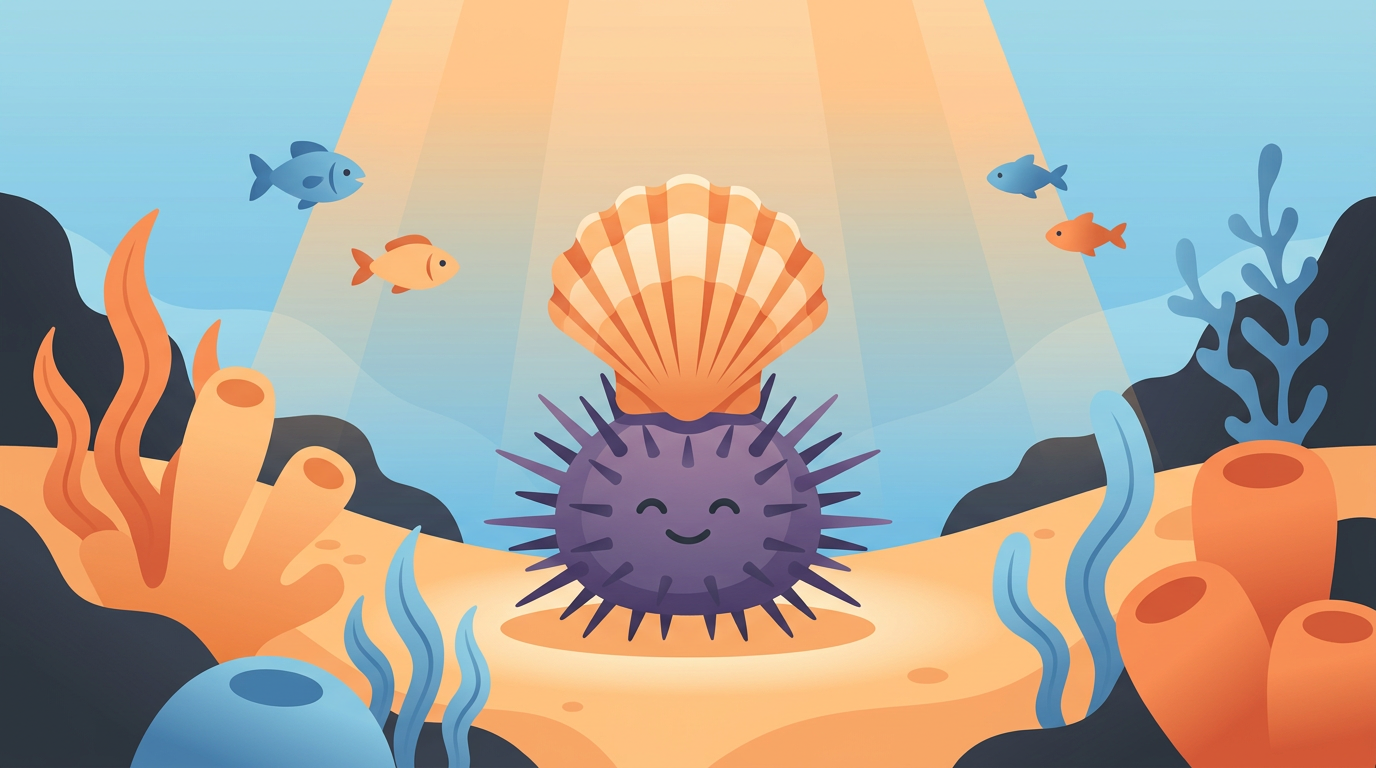
If you ever find yourself strolling along a shallow coastal reef, you might spot what looks like a spiky purple party favor wearing a clam shell as a jaunty beret.
No, you haven't contracted ocean-induced delirium. You have simply met a sea urchin engaged in one of marine biology's most endearing pastimes: the covering behavior. These prickly little spheres spend an enormous amount of energy hoisting shells, pebbles, and bits of seaweed onto their heads, turning the seafloor into what looks suspiciously like an underwater high-fashion runway.
Except, unlike human runway models, sea urchins are not trying to land a magazine cover. They are trying to survive the elements in the smartest way possible.
Powered by Hundreds of Little Suction Cups
Before we dive into why urchins wear hats, consider how they actually put them on. An urchin doesn't have arms, eyes, or a central brain. What it does have is a hydraulic system operating thousands of microscopic, flexible tube feet tucked between its spines.
When a passing shell or smooth stone lands nearby, these tube feet wake up. Acting like a coordinated fleet of tiny robotic cranes, they latch on using suction and carefully pass the object up their spines until it sits securely on top. It looks like an agonizingly slow game of crowd-surfing, but the urchin will hold onto its chosen accessory for days, refusing to let go even when the tide tries to knock it loose.
SPF: Seafloor Protection Factor
So why go through all the trouble of balancing a rock on your head?
First and foremost: sun care. Urchins often hang out in sunny, shallow coastal waters where intense ultraviolet radiation penetrates straight through the surface. Without skin, fur, or scales, their delicate internal systems are vulnerable to solar damage. By holding an opaque shell or a dense stone directly overhead, the urchin effectively creates its own personal parasol, keeping the worst of the UV rays at bay.
There is also the issue of turbulence. Shallow ocean surge can whip up loose sand, gravel, and sharp debris that will happily batter an urchin's fragile exterior. Carrying a shield on top acts like an organic hard hat, absorbing the bumps and scratches dealt by rough waves.
The Irony of Eating Your Own Umbrella
Here is where the urchin's lifestyle choices get delightfully ironic. One of an urchin's favorite snacks is kelp. In healthy marine ecosystems, towering kelp forests form thick, floating canopies that naturally block sunlight and shield the seabed below.
However, when urchin populations boom, they can be remarkably undisciplined eaters. They will literally mow down entire kelp forests, chewing through the base of the stalks until the canopy drifts away, leaving behind a sun-baked barren patch.
Having successfully demolished their own shade tree, the urchins find themselves squinting into the glare, forced to scurry around gathering pebbles to craft personal umbrellas. It is essentially the marine equivalent of chopping down your front porch awning and then realizing you need to wear a giant sombrero indoors.
And urchins are not picky about their materials, either. In areas where human trash drifts onto the seafloor, divers regularly spot urchins wearing discarded bottle caps, plastic wrappers, and synthetic scraps. While it's a stark reminder of our plastic footprint, you have to admire the urchin's hustle: shade is shade, even if it comes in neon polypropylene.
The Otterly Interesting Part
Urchins are not the only creatures playing dress-up beneath the waves. Decorator crabs carefully snip living sea anemones and sponges to paste onto their shells, while sponge crabs trim living sponges into tight-fitting helmets they hold in place with their rear legs.
What makes the urchin special, though, is its sheer simplicity. It doesn't have complex sensory organs or a brain to coordinate elaborate deception. It simply senses light and water pressure, reaches out with hundreds of squishy feet, and decides that a seashell hat solves almost all of life's problems.
Next time you head outside under a scorching midday sun, take a cue from the spikiest critter on the reef: never underestimate the power of good headwear.
Keep exploring
- When Uncle Sam’s Fictional Better Half Solved Marriage’s Oldest Argument
- Roll for Initiative, William: What If the Bayeux Tapestry Was Your Campaign Map?
- Forget 'Chatterbox': 7 Brilliant Vintage Words for People Who Talk Nonstop
- Take an Otter quiz
Otterly agree? Tell us why.
Join the conversation
Kind, funny and useful takes only — that's the otter way.
Loading comments…