Genius Minds, Silly Traps: Why Smart Animals Make Ridiculous Mistakes
From master tool-using crows to pets trapped in cardboard boxes, animal intelligence is brilliant, highly specialized, and occasionally prone to hilarious spatial miscalculations.
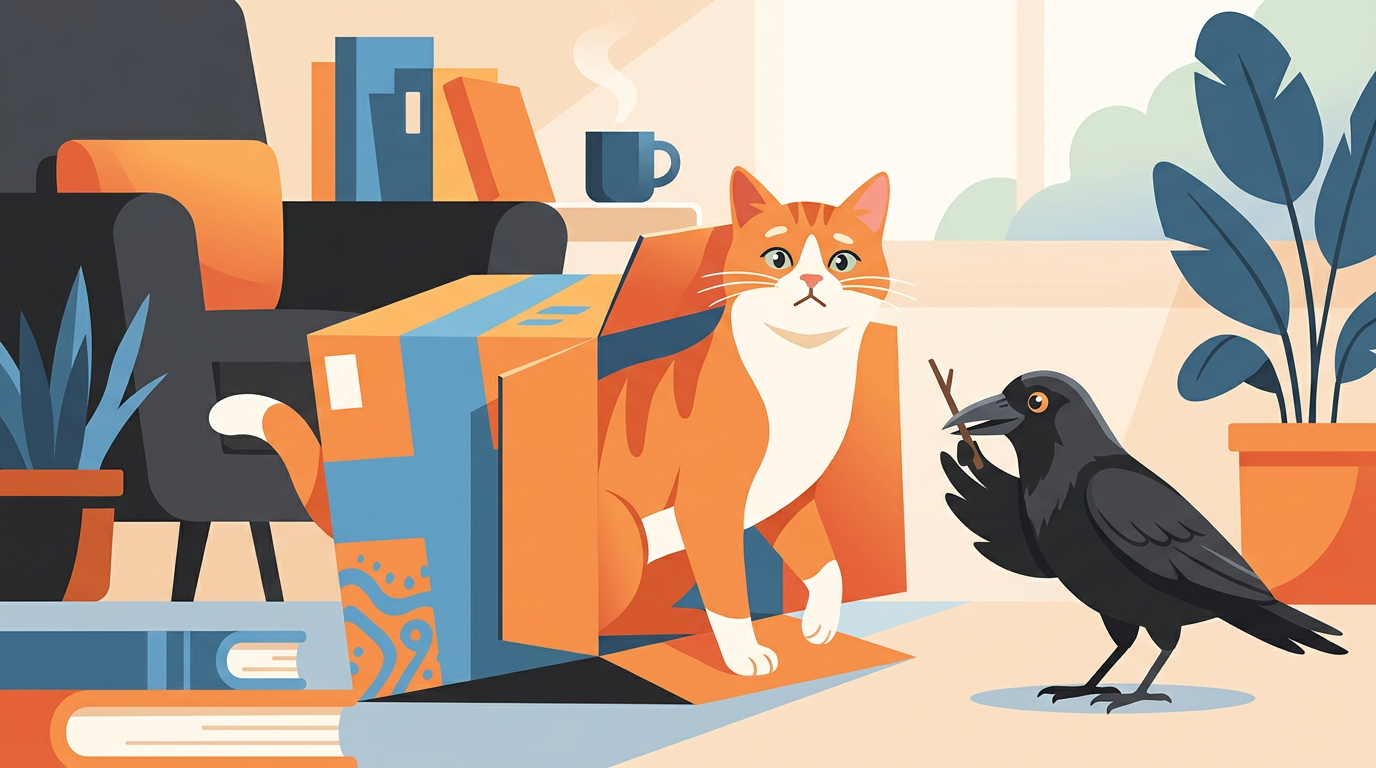
Have you ever walked into your living room to find your cat wedged impossibly into a tissue box, staring at you with a look that says, "I meant to do this"? Or maybe your dog somehow got their head lodged in a sofa cushion hole? It makes you wonder how these majestic creatures managed to thrive on this planet for thousands of years.
The truth is, there is a legendary gap between advanced animal brainpower and the disastrous consequences of pure, unadulterated curiosity.
The Physics of Optimistic Pets
When a pet decides to crawl into a cozy gap behind the refrigerator, they aren't running a complex spatial simulation in their head. They operate on a simple, timeless principle: if it looks intriguing, investigate immediately.
Pets routinely miscalculate spatial boundaries because their brains aren't naturally built for modern indoor furniture. Out in nature, squeezing into a tight rock crevice might mean safety or a tasty snack. In a modern living room, however, squeezing between dining chair legs just means you now rely on a human with a camera to untangle you.
Meanwhile, in the Avian Genius Club
To see just how brilliant animal cognition can be, you only have to look at New Caledonian crows. Researchers at the University of Cambridge found that these astounding birds can plan complex, multi-step tasks well in advance. They can select the right length of stick to reach a secondary tool, which then lets them reach a piece of food. They can even keep track of tools that are completely out of sight.
That is high-level cognitive architecture. So why does a cat—another highly capable predator—get baffled by an open doorway or trapped in a paper bag?
Why Smart Animals Make Silly Mistakes
It turns out we are asking the wrong question. Scientists at the Max Planck Institute emphasize that comparing animal minds directly to human intellect can mask their specialized abilities. Animal intelligence isn't a single ladder with humans at the top and pets somewhere on the middle rungs. Instead, intelligence is custom-tailored by specific ecological challenges.
A crow's brain evolved to solve complex foraging puzzles in the wild treetops. A cat's brain evolved for explosive speed and hyper-focused stalking. Neither species evolved to navigate clothes hampers, window blinds, or plastic storage containers. When an animal gets trapped in an awkward spot, it isn't a sign of low intelligence—it's a high-powered brain running into a totally foreign environment.
The Otterly Interesting Part
Before we judge our pets too harshly for their embarrassing tight-squeeze blunders, let's take a quick look in the mirror. Humans possess abstract reasoning, calculus, and space travel, yet we still push doors that clearly say "Pull" and manage to get our fingers stuck in park benches. Curiosity is an evolutionary risk-taking mechanism. The drive to explore new spaces is what helps species discover food and shelter, even if it occasionally ends with a bewildered pet wearing a laundry basket like armor.
The Final Verdict
The next time you have to rescue your furry friend from behind the dryer, don't worry about their brainpower. They aren't silly; they are specialized evolutionary marvels who just happened to overestimate the doorway to the snack cabinet. Help them out, snap a quick photo, and give them a treat—they tried their best!
Keep exploring
- The Ultimate Penny-Pincher Road Trip: Navigating the World of Elongated Coins
- The Rogue Carpenter Who Turned a Tucson Street into a Secret Salad Bar
- Why Did 17-Year-Olds in the 1970s Look Like 42-Year-Old Accountants?
- Take an Otter quiz
Have something to add?
Join the conversation
Kind, funny and useful takes only — that's the otter way.
Loading comments…