Why Wombats Poop Cubes (And Refuse to Let Their Property Values Roll Away)
Australia's favorite burrowing marsupials aren't just adorable—they're biological engineers who solved a rolling property crisis using pure intestinal physics.
The Ultimate Territorial Real Estate Problem
Imagine living in the Australian bush. You're a wombat—essentially a furry, short-legged tank with a passion for digging deep, cozy burrows. You work hard on your kingdom, and you want everyone in the neighborhood to know it. How do you leave a clear business card for your rivals? You leave a scent marker high up on a nice rock or log where the wind can carry the news.
There's just one tiny design flaw with standard animal waste: round things roll downhill.
If you leave a classic spherical dropping on a smooth log, gravity does its cruel work. Your territorial signpost bounces down the ridge, lands in a muddy creek, and suddenly your property line disappears. For a stubborn marsupial who values clear boundaries, that simply will not do.
Enter the Intestinal Minecraft Engine
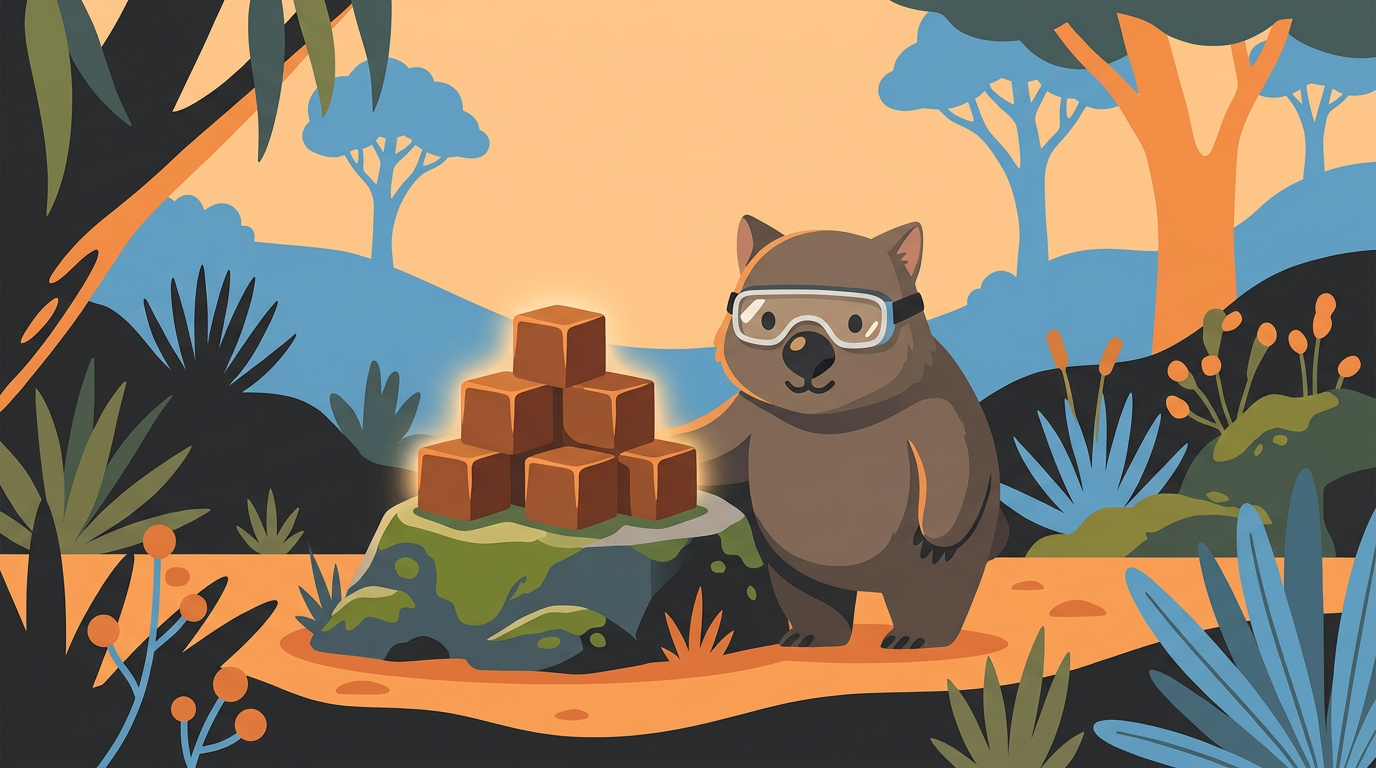
Nature came up with a ridiculously clever solution. Wombats are the only known animals in the entire world that excrete naturally occurring cubes.
No, they don't manually shape them with their paws like tiny furry pottery artists (a hilarious bit of folklore, but sadly untrue). And no, they aren't building decorative Lego towers to impress potential romantic partners.
The magic happens deep inside the final stretch of the wombat's digestive tract. While most mammalian intestines expand and contract evenly around digesting food—like a classic sausage casing—a wombat's gut possesses variable elasticity. Parts of the intestinal wall are stiff and rigid, while other parts are surprisingly stretchy.
As waste moves through the final eight percent of the intestine, periodic contractions press against these uneven walls, flattening the edges and carving sharp, tidy right angles. By the time it exits, you have a pristine, six-sided brick.
High-Volume Architecture
A single wombat can produce up to 100 of these little organic building blocks in a single night. Because they intentionally deposit them on elevated spots like rocks, fallen tree trunks, and small mounds, those flat edges act like natural parking brakes. A cube stays exactly where it’s put, ensuring the wombat's scent message remains loud, clear, and firmly atop the hill.
Scientists were so thoroughly delighted by the fluid dynamics and biomechanics of this phenomenon that a team of researchers earned an Ig Nobel Prize in 2019 just for unravelling the physics behind the wombat gut.
The Otterly Interesting Part
It is genuinely hilarious to realize that humans spent thousands of years inventing complex brick molds and manufacturing plants just to stack square objects, while wombats evolved an automatic internal block factory purely because they were tired of their signposts rolling into the bushes. Nature really is the ultimate practical engineer.
The Verdict on Nature's Cubism
So next time you struggle with a piece of flat-pack furniture or admire a crisp right angle, give a quick nod of respect to Australia's heavy-duty burrowers. They took one look at gravity and decided to re-engineer geometry from the inside out.
Got a favorite bizarre animal fact that sounds like complete fiction? Share it with us!
Keep exploring
- A Fisherman Gave CPR to a Baby Otter—Then Came the Late-Night Car Drive
- This is what the future of media looks like | Hamish McKenzie
- What if the climate movement felt like a house party? | Matthew Phillips
- Take an Otter quiz
Otterly agree? Tell us why.
Join the conversation
Kind, funny and useful takes only — that's the otter way.
Loading comments…